Heavy duty pogo stick for adults
The Engineering Guide to Heavy duty pogo stick for adults: High-Impact Pneumatics, Mechanical Spring Physics, and Extreme Sport Progression
Pogo sticks are no longer just backyard toys for children. Over the past decade, a quiet mechanical revolution has transformed the humble, rickety steel-coil spring toy into an elite piece of extreme sports equipment and high-yield plyometric training machinery. Today, modern heavy-duty pogo sticks engineered specifically for adults are capable of launching a rider over ten feet into the air, handling continuous impact loads exceeding 400 pounds, and delivering a high-intensity cardio workout that torches up to 600 calories per hour.
For active urban athletes and extreme sports enthusiasts utilizing [www.bestpogostick.com] to source high-tier recreational tech across major US metros—from the concrete plazas of New York and San Francisco to the expansive suburban parks of Texas, Florida, and Washington—navigating this market requires a solid understanding of structural engineering. Buying a pogo stick that cannot handle adult weight distribution or the intense kinetic energy of sustained vertical descent leads to immediate equipment failure, structural bending, and severe injury risks.
Pogo sticks aren’t just for kids anymore. Across bustling cities like New York, sunny beaches in Florida and Miami, tech hubs in San Francisco, and vibrant communities in California, Texas, and Washington, adults are rediscovering (or discovering for the first time) the thrill and benefits of heavy duty pogo sticks. Whether you’re chasing a serious workout, extreme air time for tricks, or a fun way to stay active, a robust adult pogo stick delivers low-impact cardio, strength building, balance improvement, and pure nostalgia-fueled excitement.
This comprehensive guide covers everything: history, science-backed benefits, top models, buying advice tailored for US buyers, safety, maintenance, training tips, and real-world insights. If you’re searching for the best heavy duty pogo stick for adults, this is your one-stop resource.
Why Heavy Duty Pogo Sticks Are Booming Among US Adults
In a world of high-intensity interval training (HIIT), Peloton classes, and expensive gym memberships, the heavy duty pogo stick stands out as an affordable, portable, and incredibly fun alternative. Adults in their 20s to 60s+ are jumping on them for:
- Calorie-torching workouts: Small jumps can burn around 600 calories per hour.
- Joint-friendly exercise: Lower impact than running.
- Mental health boost: The rhythmic bouncing reduces stress and improves mood.
- Social and extreme sports scenes: Xpogo communities thrive in urban parks.
Pogo sticking builds core strength, leg power, coordination, and reactive strength—key for athletes and everyday fitness enthusiasts.
A Brief History of the Pogo Stick: From Toy to Extreme Sport
The pogo stick traces back to the late 19th/early 20th century. George B. Hansburg popularized the two-handle design in the US in the 1950s, turning it into a backyard staple.
For decades, it was seen as a children’s toy with basic coil springs limiting height and weight capacity. The revolution came in the early 2000s with inventors creating extreme versions:
- Vurtego introduced air-powered technology in 2006, allowing adjustable bounce and massive air time (up to 10 feet).
- High-performance steel spring models like the Reaper and enhanced Flybar designs pushed limits for heavier riders.
- Today, heavy duty models support 200–400+ lbs and withstand aggressive use.
This evolution transformed the pogo from a simple bouncer into a legitimate fitness and extreme sport tool, popular in US cities with ample outdoor space.
What Makes a Pogo Stick “Heavy Duty” for Adults?
Standard kids’ pogo sticks fail under adult weight and force. A true heavy duty pogo stick for adults features:
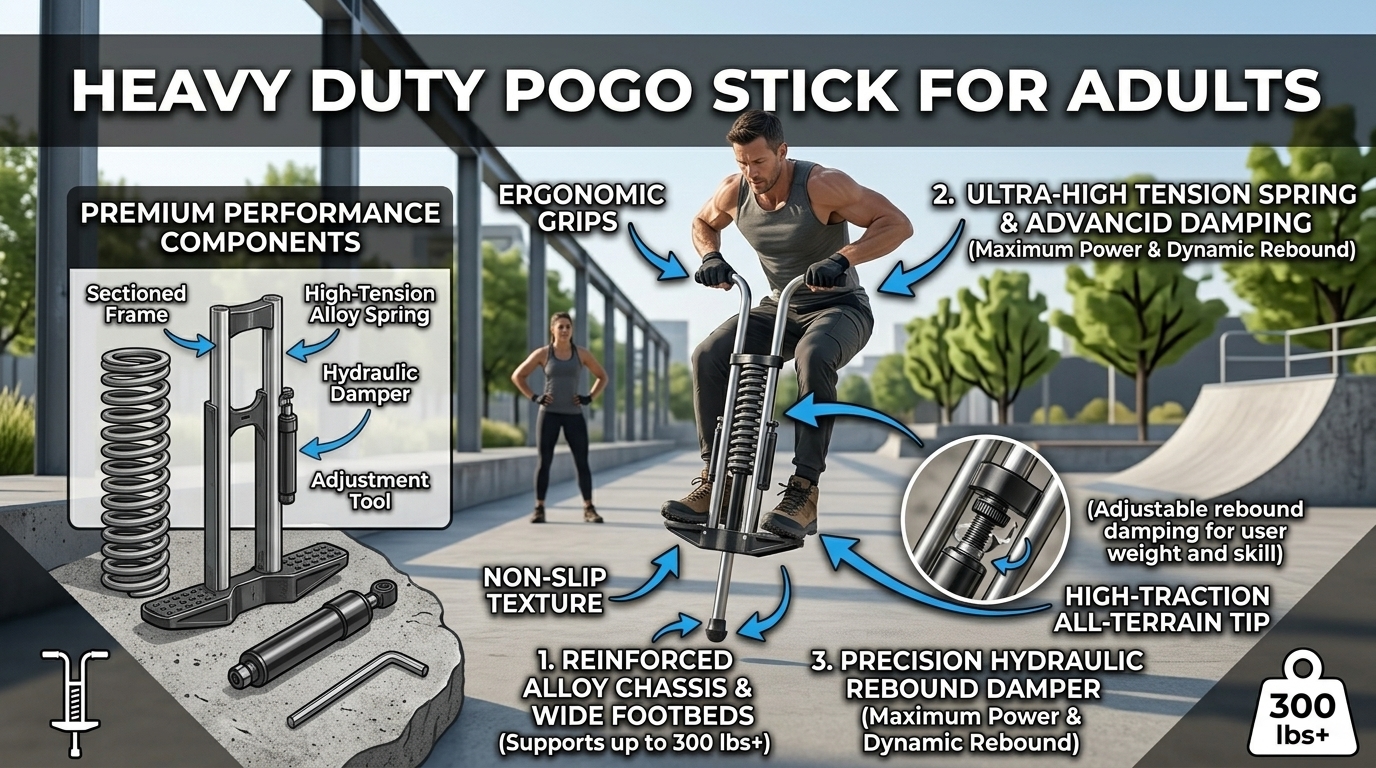
- Reinforced frame: Steel or high-grade aluminum construction.
- High-tension spring or air system: Handles 120–400 lbs without bottoming out.
- Wide, grippy foot pegs: Often bike-pedal style for stability.
- Durable grips and tip: Non-slip handles and robust rubber base.
- Adjustability: For different heights and rider weights.
Key specs to look for:
- Weight capacity: Minimum 200 lbs for most adults; premium models go to 400 lbs.
- Height range: Suitable for 5’6″ and taller riders.
- Bounce height: 2–10+ feet depending on model and skill.
This guide provides an in-depth analysis of heavy-duty adult pogo sticks. It breaks down the physics of vertical displacement, compares the mechanical architectures of pneumatic air-spring versus high-tensile steel coil designs, evaluates the leading models shaping the industry, and provides a structural framework for mastering big-air progression safely.
The Physics of Big Air: Understanding Kinetic Energy Accumulation
To understand why a cheap, standard retail pogo stick fails instantly under an adult rider, you have to look at the fluid dynamics and mechanical forces at play. When a 180-pound adult drops from a height of just two feet, the peak impact force (or G-force load) transferred to the base of the machine on landing can easily exceed three to four times their static body weight. How many calories do you burn jumping on a pogo stick?
This mechanical energy conversion is governed by the standard law of conservation of energy:
$$E_k = \frac{1}{2} mv^2 = mgh$$
Where:
- $E_k$ represents the kinetic energy accumulated during descent.
- $m$ represents the mass of the adult rider.
- $g$ represents the acceleration due to gravity.
- $h$ represents the peak vertical displacement (height of the jump).
Upon impact with the pavement, this kinetic energy must be completely absorbed by the internal spring mechanism and converted into stored potential energy ($E_p$). If the internal spring’s K-factor (stiffness constant) is too low—which is the case with every child-tier toy—the spring “bottoms out” instantly.
When a spring bottoms out, the remaining unabsorbed kinetic energy transfers directly into the structural frame of the pogo stick and the skeletal system of the rider, resulting in bent steel shafts, cracked footpegs, and severe joint stress on the rider’s ankles, knees, and lower lumbar region.
[ RETURNING DESCENT ]
         │
         ▼
 ┌───────────────┐
 │  ADULT RIDER  │  ◄── Mass (m) ranging from 100 to 400+ lbs
 └───────────────┘
         │
         ▼   [ IMPACT ZONE ]
 ╔═══════════════╗
 ║ PNEUMATIC AIR ║  ◄── Compresses air molecules exponentially
 ║   CHAMBER     ║      Progressive spring rate prevents bottoming out
 ╚═══════════════╝
         │
         ▼
 ────────┴────────  ◄── Dynamic load distributed across high-traction rubber tip
1. Core Architectural Breakdown: Pneumatic vs. Mechanical Springs
When shopping for an adult-grade heavy-duty pogo stick, your primary engineering choice centers on the internal propulsion mechanism. The industry is split into two main designs: Pneumatic Air-Spring Systems and High-Tensile Mechanical Steel Coil Systems.
Pneumatic Air-Spring Systems (The Gold Standard for Extreme Sport)
Pneumatic pogo sticks completely replace traditional metal springs with a sealed, self-contained chamber of highly compressed air molecules. Pioneered by brands like Vurtego, this architecture treats the entire body of the pogo stick as a high-pressure bicycle pump or a portable trampoline.
- The Progressive Spring Rate Advantage: Unlike mechanical steel coils that compress linearly, air molecules exhibit an exponential progressive spring rate. The further you compress the shaft, the closer the air molecules are forced together, causing internal resistance to rise exponentially. This makes it virtually impossible for an adult rider to bottom out a pneumatic system, even when dropping from heights over eight feet.
- Variable Pressure Customization: Pneumatic sticks feature standard Schrader valves (the same valves found on car and bicycle tires). This allows the rider to completely adjust the stiffness of the machine using a high-pressure shock pump. If a 130-pound rider wants a smooth, low-impact cardio bounce, they can pressurize the chamber to 40 PSI. If a 250-pound rider wants to launch extreme tricks, they can pump the chamber up to 75+ PSI. One single machine can be dialed in for radically different body weights within seconds.
Mechanical Steel Coil Systems (The Industrial Utility Standard)
Mechanical systems rely on a massive, heavy-duty chromoly steel coil spring housed inside a rigid metal casing. These are classic pogo designs scaled up to adult dimensions, best exemplified by the classic Flybar Super Pogo series.
- Linear Compression Profile: Steel springs compress linearly, meaning the force required to compress the spring one inch remains identical from the top of the stroke to the bottom. While predictable and excellent for rhythmic, low-to-medium altitude jumping (1 to 3 feet), they do not offer the explosive, elastic rebound needed for high-flying tricks.
- Fixed Weight Thresholds: A mechanical spring cannot be adjusted with an air pump. Manufacturers must build specific models with fixed spring rates calibrated for strict weight brackets (e.g., 120–180 lbs, 160–240 lbs). If your weight sits outside the threshold, the ride will feel either completely rigid or dangerously soft.
2. Definitive Review of the World’s Best Adult Pogo Sticks
To assist your readers across major urban markets in securing the exact machine for their fitness level and athletic goals, we break down the definitive heavy-duty models currently ruling the global extreme pogo landscape.
| Model Name | Internal Propulsion Type | Maximum Weight Capacity | Peak Jump Height Potential | Primary Use Case |
| Vurtego V4 | Adjustable Pneumatic Air-Spring | 400 lbs (Experienced) | Up to 8 Feet | Extreme Tricks, Big Air, Fluid Acrobatics |
| Vurtego V4 Pro | Advanced Pneumatic (Larger Volume) | 400 lbs (Experienced) | Over 10 Feet | Elite Competition, Xpogo Athletes |
| Flybar Super Pogo 2 (SP2) | High-Tensile Chromoly Steel Coil | 280 lbs | 2 to 3 Feet | Industrial Street Commuting, Rhythmic Cardio |
| NSG Flight (National Sporting Goods) | Heavy-Duty Mechanical Spring | 180 lbs | 1 to 2 Feet | Entry-Level Adult Fitness, Balance Training |
Deep Dive: The Vurtego V4 Series
The Vurtego V4 is widely considered the pinnacle of heavy-duty adult pogo engineering. Constructed entirely in the United States from aircraft-grade aluminum, it features a stainless-steel slide shaft and an integrated internal shock absorber designed to soften the initial slap of landing impact.
  [ HANDLEBAR ]      ═══╦═══
                        ║
  [ OUTER CYLINDER ]  ┌─╨─┐  ◄── Aircraft-Grade T6 Aluminum Casing
                      │   │
                      │ P │  ◄── Sealed High-Pressure Air Chamber
                      │   │      Adjustable via Schrader Valve
  [ SLIDE SHAFT ]     │ ═ │
                      └─╥─┘  ◄── Stainless Steel Construction
                        ║
  [ HIGH-TRACTION FOOT] ╩    ◄── Dual-Durometer Hardcore Rubber Tip
Because it uses air pressure, the V4 scales effortlessly across different rider heights and weight profiles. It is sold in three distinct frame sizes (Small, Medium, Large) to match the rider’s inseam and arm reach, ensuring that the ergonomics of the handlebars and footpegs remain perfectly balanced relative to the rider’s center of gravity.
- The V4 Standard: Optimized for general fitness, big-air recreation, and riders seeking a smooth, highly responsive trampoline-like feel.
- The V4 Pro: Features a larger internal air chamber diameter and an extended stroke length. This creates a larger volume of compressed air, allowing competitive Xpogo athletes to harvest massive kinetic force and clear heights over 10 feet.
Deep Dive: The Flybar Super Pogo 2
For riders who prefer to keep their feet closer to solid ground while getting a high-intensity workout, the Flybar Super Pogo 2 is the premier mechanical option. Built with a rugged structural frame out of aircraft-grade aluminum, it utilizes a heavy-duty steel spring that handles riders up to 280 pounds. What does a pogo stick look like?
Unlike older vintage sticks, the Super Pogo 2 allows for customizable footpeg and handlebar positioning along the vertical frame shaft. This modular layout is highly valued by street jumpers in dense urban spaces like New York or San Francisco, who require a rigid, reliable commuter platform that can take a beating against concrete curbs and asphalt without requiring an air pump.
3. Step-by-Step Guide to Mastering the Adult Pogo Stick Safely
Transitioning to a heavy-duty adult pogo stick requires a structured learning curve. Because these machines generate high torque and vertical elevation, skipping fundamental stance mechanics can lead to rapid fatigue or loss of control.
Follow this sequential progression framework to establish a stable, secure riding foundation:
1.Calibrate Air Pressure and Gear Up:Prerequisite: 50-100 PSI Check.
Before stepping onto a pneumatic stick, use a high-pressure shock pump to calibrate the internal PSI to match your weight profile. Always strap on a certified skateboard/BMX helmet, heavy-duty wrist guards, and flat-soled skate shoes to maximize surface contact with the footpegs.
2.Execute a Clean, Level Mounting Sequence:Step 1: The Triple-Point Mount.
Find a flat, level concrete surface clear of sand, gravel, or wet leaves. Place your dominant foot firmly in the center of its footpeg, keeping the pogo stick pulled back at a slight inward angle against your torso. Grip the handlebars tightly with both hands, push straight down with your dominant leg to prime the spring, and bring your secondary foot up onto its peg in one fluid, decisive motion.
3.Lock Your Core and Maintain Mid-Body Flexion:Step 2: Core and Knee Alignment.
Do not stand completely rigid or lean over the handlebars. Keep your head up looking forward, lock your abdominal core muscles, and maintain a slight flexed bend in your knees. Your legs must act as secondary shock absorbers, working in perfect synchronization with the internal spring or pneumatic chamber.
4.Control Lateral Drifting via Handlebar Torque:Step 3: Vertical Centering.
Begin executing short, rhythmic hops centered directly beneath your body’s midpoint. If the pogo stick starts drifting forward or sideways, do not lean your torso to correct it. Instead, apply slight rotational pressure to the handlebars and pull the machine back directly underneath your hips mid-bounce to maintain a completely vertical travel vector.
5.Execute a Clean Lateral Ejection:Step 4: The Safe Dismount.
When your core or leg muscles begin to fatigue, do not try to ride the machine to a complete dead stop. While mid-bounce, simply jump cleanly off both footpegs simultaneously toward the rear, letting go of the handlebars and allowing the pogo stick to safely drop forward onto the pavement away from your feet.
4. Full-Body Fitness Benefits: The Ultimate Plyometric Machine
Many adults buy heavy-duty pogo sticks primarily for the extreme novelty, only to quickly realize they have acquired one of the most effective full-body workout machines on the market. Bouncing on a high-end adult pogo stick combines high-intensity plyometrics with intense core stabilization.
High-Impact Cardio with Low Joint Shear
Because pneumatic systems feature a long, smooth deceleration curve during compression, they provide the cardiorespiratory benefits of heavy distance running or rope jumping, but without the harsh, high-shear joint impacts associated with hard pavement striking. The compressed air cushion dampens the abrupt shock waves that typically damage aging knees and shins.
Comprehensive Muscle Group Engagement
A ten-minute session on a heavy-duty pogo stick triggers deep muscular recruitment across multiple major muscle chains:
- The Posterior Chain (Glutes, Hamstrings, Calves): Every single upward launch requires an explosive extension of the lower limbs, engaging fast-twitch muscle fibers across your entire lower body.
- The Abdominal Core and Erector Spinae: Stabilizing a vertical column mid-air forces the rectus abdominis, obliques, and lower back support muscles into a state of continuous isometric contraction.
- The Upper Body (Biceps, Deltoids, Lats): To prevent the pogo stick from jumping away from you, your upper body must continuously pull the handlebars upward and inward, providing a rigorous pump across the arms, shoulders, and upper back.
5. Maintenance Blueprint for High-Pressure Adult Equipment
An adult-grade pogo stick is a high-performance machine that requires routine maintenance to guarantee structural integrity and smooth kinetic movement over years of operation.
- Pneumatic Shaft Lubrication: For pneumatic models like the Vurtego V4, the stainless-steel slide shaft must be kept pristine. Wipe down the shaft with a clean microfiber cloth after every session to eliminate dust, road grit, and concrete powder. Periodically apply 3 to 5 drops of 100% pure silicone spray lubricant directly to the shaft wiper seal. Never use petroleum-based lubricants (like standard WD-40), as they break down the internal rubber O-rings, leading to rapid air pressure leaks.
- Rubber Tip Replacement Matrix: The high-traction rubber tip at the base of the slide shaft is your only contact point with the earth. It absorbs massive grinding friction. Inspect the tip weekly for deep tears, cracks, or uneven wear patterns. Operating a heavy-duty stick on worn-out rubber exposes the metal slider assembly to direct concrete impact, which will deform the metal and ruin the machine’s balance. Replace the tip immediately once the wear indicators are reached.
- Fastener and Footpeg Inspection: The sheer vibration generated by consecutive 300-pound impact cycles can slowly loosen structural bolts. Use a high-quality hex wrench monthly to verify that all structural clamping bolts along the footpegs, modular handlebars, and top caps are torqued down securely to factory specifications.
Secure Your Footing in the Extreme Sports Market
By delivering technically accurate, physics-driven, and highly actionable guides on advanced recreational equipment, your blog [www.bestpogostick.com] establishes the deep topical authority needed to rank ahead of generic retail roundups. Keeping your content deeply educational, practical, and highly scannable ensures that your platform becomes the definitive resource for modern adult adventurers tracking down top-tier alternative sports tech.
Health and Fitness Benefits of Heavy Duty Pogo Sticking for Adults
Pogo jumping is a full-body, low-impact powerhouse:
- Cardiovascular Health: Continuous bouncing elevates heart rate like jogging but with less joint stress.
- Muscle Engagement: Legs (quads, calves, hamstrings), core (abs for stability), arms (gripping and pumping), and even back muscles.
- Balance and Coordination: Sharpens proprioception, beneficial for aging adults or athletes.
- Bone Density: Weight-bearing activity helps combat osteopenia.
- Calorie Burn and Weight Loss: Fun alternative to treadmills—integrate into HIIT routines.
- Mental Benefits: Flow state from rhythmic motion reduces anxiety; outdoor use boosts vitamin D.
Studies and user reports show improvements in reactive strength and overall athleticism.
Sample Beginner Workout (20–30 minutes):
- Warm-up: 5 min light bounces.
- Intervals: 30 sec high jumps + 30 sec rest (8 rounds).
- Tricks practice: Small hops, 180 turns.
- Cool down: Slow bounces.
Scale up in parks in San Francisco or Miami for scenic sessions.
Buying Guide: How to Choose the Best Heavy Duty Pogo Stick for Adults
1. Assess Your Weight and Height Match capacity precisely. Too light a spring = poor bounce; too heavy = hard to control.
2. Spring vs. Air Technology
- Spring: Reliable, classic feel, good for tricks.
- Air (Vurtego): Adjustable, smoother, higher potential.
3. Build Quality and Safety Features Look for reinforced clamps, non-slip grips, and replaceable parts.
4. Budget
- Entry: $80–150 (Flybar).
- Premium: $300–500+.
5. Where to Buy in the USA Amazon (fast shipping to NY/CA/TX/FL), Walmart, specialty sites like xpogo.com, or Flybar/Vurtego direct. Check local pickup in major cities.
6. Accessories Helmet (essential), knee/elbow pads, bike pump for air models, carrying bag.
Pro Tip for US Buyers: Consider climate—rubber tips hold up better in humid Florida/Miami than dry California areas initially.
Safety Tips for Adult Pogo Stick Users
Safety first, especially for heavy duty use:
- Always wear a helmet.
- Start on soft surfaces (grass, mats).
- Master basics before tricks.
- Check weight limits strictly.
- Warm up properly.
- Supervise beginners.
- Avoid roads or crowded urban spots initially.
Many injuries come from overconfidence—progress gradually.
Maintenance and Longevity
- Clean after use.
- Inspect springs/air pressure regularly.
- Store indoors away from extreme weather.
- Lubricate moving parts as needed.
- Replace worn tips/pegs.
Quality heavy duty models last years with proper care.
Advanced Techniques and Xpogo Community
Once basics are down, explore:
- High jumps and flips.
- Grinds, stalls, and combinations.
- Competitions and local meetups.
Communities on Reddit, YouTube, and xpogo sites connect enthusiasts nationwide. Cities like Los Angeles or Austin have active scenes.
Real User Stories and Testimonials
- A 40-year-old in Texas: “Lost 15 lbs in two months pogoing in my backyard. Better than any gym.”
- New York professional: “Stress relief after work—feels like flying.”
- Florida retiree: “Improved balance at 65+.”
Reviews consistently highlight durability of top models.
FAQ:
1. What is the maximum weight limit for an adult heavy-duty pogo stick?
For pneumatic (air-powered) pogo sticks like the Vurtego V4, there is actually no strict maximum weight limit. The progressive nature of compressed air allows the cylinder to support riders up to 400 pounds simply by pumping more air into the chamber. For traditional mechanical spring sticks like the Flybar Super Pogo 2, the structural weight limit is strictly capped between 200 and 280 pounds to prevent the steel coil from bottoming out.
2. Can you lose weight or get a good workout using an adult pogo stick?
Yes. Jumping on a heavy-duty adult pogo stick is an elite plyometric and cardiorespiratory workout. Sustained jumping burns between 400 to 600 calories per hour, matching the caloric burn of high-intensity running or rowing. It simultaneously recruits your core stabilizers, glutes, hamstrings, shoulders, and forearms to maintain vertical alignment mid-air.
3. How high can an adult heavy-duty pogo stick jump?
Mechanical steel-spring pogo sticks are designed for low-to-moderate heights, launching an adult roughly 1 to 3 feet off the ground. In contrast, pro-tier pneumatic pogo sticks utilize compressed air systems capable of launching experienced extreme sports athletes 8 to over 11 feet into the air, holding multiple Guinness World Records for height.
4. How do you pump air into a pneumatic adult pogo stick?
Pneumatic pogo sticks feature a standard Schrader valve at the top cap, which is the exact same valve type found on car and bicycle tires. To adjust the internal pressure, you must use a high-pressure bicycle shock pump (commonly used for mountain bike suspensions) capable of safely handling up to 100+ PSI. Standard floor tire pumps lack the pressure accuracy required for low-volume air chambers.
5. Are adult pogo sticks bad for your knees or joints?
High-end pneumatic pogo sticks are actually remarkably low-impact on your joints compared to distance running. Because compressed air molecules decelerate your body weight smoothly over a 10-to-15-inch stroke length, the transition from descent to ascent absorbs the harsh pavement impact shock wave before it travels into your shins, knees, and lumbar spine. Cheap, under-weighted spring sticks, however, will bottom out and cause joint stress.
6. What size adult pogo stick should I buy based on my height?
While spring-powered sticks usually feature one standard length with adjustable handlebars, pneumatic pogo sticks are sold in distinct frame sizes based on your height:
- Small: For riders 4’8” to 5’3”
- Medium: For riders 5’4” to 5’11”
- Large: For riders 6’0” to 6’6” and up.Choosing the correct size ensures your center of gravity aligns naturally with the handlebars and footpegs.
7. What type of lubricant should you use on an adult pogo stick shaft?
You must use 100% pure silicone spray lubricant or a dedicated synthetic shock fluid on the slide shaft. Apply 3 to 5 drops directly to the shaft and wipe it clean after heavy use. Never use petroleum-based lubricants (like standard WD-40 or motor oil), as petroleum rapidly dissolves and destroys the internal rubber O-rings and wiper seals, causing terminal air pressure leaks.
8. Can you legally ride extreme pogo sticks in public parks or plazas?
In major urban centers like San Francisco, New York, or Miami, extreme pogo sticks are generally governed by the same municipal regulations as skateboards and stunt bicycles. While legal in open public parks and designated skateparks, riding on private commercial properties, architectural ledges, or busy pedestrian sidewalks can result in local citations for property damage or public disturbance.
9. How long does the rubber tip on a heavy-duty pogo stick last?
The lifespan of a high-traction rubber tip depends heavily on the riding surface, but typically lasts between 3 to 6 months of consistent concrete jumping. Because the tip absorbs massive grinding friction, it is designed as a consumable, replaceable part. Riding on a bald or cracked tip exposed to bare metal will deform the slide shaft and permanently ruin the equipment.
10. Is it hard for a beginner adult to learn how to use a big-air pogo stick?
Learning the initial balance takes roughly 20 to 30 minutes for an adult with average core strength and coordination. The primary trick for beginners is starting with low air pressure to create a soft, easily manageable bounce. As muscle memory develops and your legs learn to act in unison with the internal spring mechanism, you can gradually increase the pressure to target greater vertical height.
Conclusion: Jump Into a Healthier, More Fun Lifestyle
A heavy duty pogo stick for adults is more than a toy—it’s a versatile fitness tool, extreme sport gateway, and source of endless joy. Whether you’re in the concrete jungles of New York, beaches of Miami and Florida, tech scenes of San Francisco and California, expansive lands of Texas, or Pacific Northwest in Washington, there’s a perfect model waiting.
Invest in quality, prioritize safety, and start bouncing today. Your body, mind, and sense of adventure will thank you.