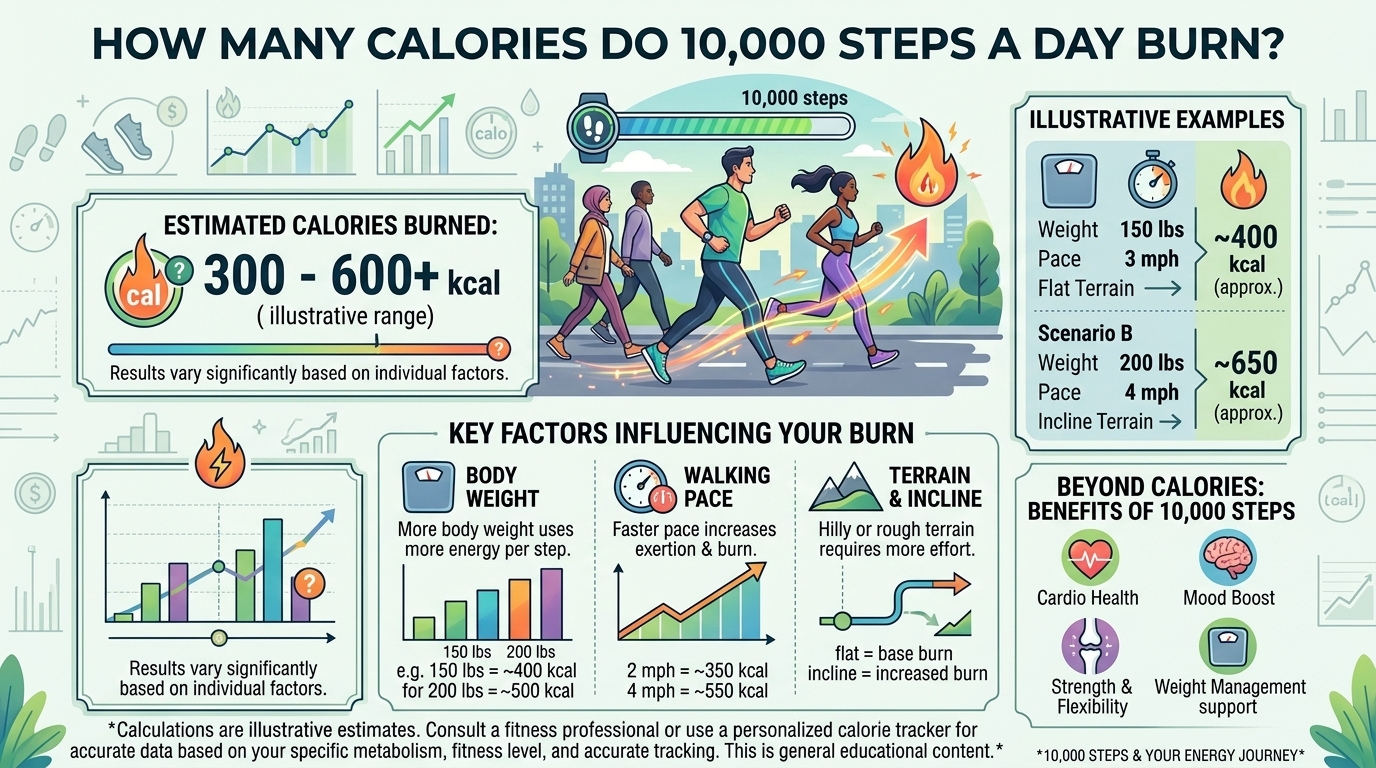
How many calories do 10000 steps a day burn?
How many calories do 10000 steps a day burn? Step out of your front door on a crisp morning in Seattle, Washington, take a midday power walk through the bustling grid of Manhattan, New York, stroll through the suburban expanses of Houston, Texas, or hit the beach boardwalks of San Diego, California. No matter where you are in America, you will see thousands of people tracking a single, magical health metric on their wristwatches, rings, and smartphones: 10,000 steps.
The “10,000 steps a day” benchmark has become the ultimate global gold standard for personal fitness. It is the default daily goal pre-programmed into almost every smartwatch, step tracker, and health app on earth.
But if you are walking to manage your weight, a critical question arises: How many calories do 10000 steps a day actually burn?
If you search the internet for a quick answer, you will run into a wall of generic, conflicting numbers. Some surface-level blogs claim it burns a flat 500 calories; others boldly promise a massive 1,000-calorie deficit. The truth is far more fascinating—and highly individual. At bestpogostick.com, we look at health, mechanics, and human kinetic movement through a scientifically rigorous lens.
This comprehensive guide breaks down the precise math, biological variables, and mechanical laws that determine exactly how much energy your body expends when covering 10,000 steps, along with actionable ways to maximize your daily caloric burn.
The Master Matrix: How many calories do 10000 steps a day burn!
Before diving into the underlying biological equations, use this scannable reference table compiled from metabolic data. It outlines approximately how many calories a person will burn by taking 10,000 steps at a moderate pace (~3.0 mph) based on their total body weight:
| Body Weight (lbs) | Body Weight (kg) | Est. Distance Covered (Miles) | Total Energy Burned (Calories) | MET Value (Moderate Pace) |
| 120 lbs | 54.4 kg | ~4.5 to 5.0 Miles | ~300 – 350 kcal | 3.0 METs |
| 150 lbs | 68.0 kg | ~4.5 to 5.0 Miles | ~380 – 440 kcal | 3.0 METs |
| 180 lbs | 81.6 kg | ~4.5 to 5.0 Miles | ~460 – 520 kcal | 3.0 METs |
| 210 lbs | 95.3 kg | ~4.5 to 5.0 Miles | ~540 – 610 kcal | 3.0 METs |
| 240 lbs | 108.9 kg | ~4.5 to 5.0 Miles | ~620 – 700 kcal | 3.0 METs |
1. The Core Scientific Math: Understanding METs and Weight
To understand why calorie calculators give widely varying answers, we must look at the fundamental physics of human locomotion. Walking is the act of physically moving your mass across a physical distance against the resistance of gravity. Therefore, your weight is the single largest factor in determining energy expenditure.
                  [ Total Energy Expenditure ]
                               |
      +------------------------+------------------------+
      |                        |                        |
      v                        v                        v
[ Metabolic Rate (BMR) ]   [ Body Mass (Weight) ]   [ Kinetic Variables ]
 - Basal internal organ     - Heavy mass requires    - Incline gradient
   energy consumption.        more muscular force.     - Walking velocity
To calculate the precise energy cost of any physical activity, sports scientists use a metric known as the Metabolic Equivalent of Task (MET). One MET is defined as the amount of oxygen consumed while sitting completely at rest, which equates to roughly 1 calorie per kilogram of body weight per hour ($1 \text{ kcal/kg/hour}$).
When you transition from sitting to walking, your MET value increases based on your velocity:
- Slow, Casual Stroll (2.0 mph): 2.0 to 2.5 METs
- Brisk Brisk Walk (3.0 mph – 3.5 mph): 3.0 to 3.8 METs
- Fast Power Walk (4.0 mph – 4.5 mph): 4.3 to 5.0 METs
The Metric Equation For Walking
If you want to calculate your exact caloric burn per minute of walking, the standardized medical formula is:
$$\text{Calories Burned per Minute} = \frac{\text{MET} \times 3.5 \times \text{Body Weight in kg}}{200}$$
Because 10,000 steps typically takes a person between 80 to 100 minutes to complete at a moderate pace, a heavier body mass requires significantly more muscular force and oxygen consumption to cover the exact same step count as a lighter body mass, resulting in a higher total calorie burn.
2. The Big Four Variables: Why Your Tracker Might Be Lying
If you rely solely on a basic step-counting wristwatch, your data might be heavily flawed. Your body does not burn calories based on a simple digital counter ticking up to 10,000. It reacts to four massive real-world variables:
A. Total Mass and Body Composition
As established, a higher mass increases energy expenditure. However, body composition adds a vital layer of nuance. Muscle tissue is highly metabolically active compared to adipose tissue (fat).
If two individuals both weigh 180 pounds, but one is a lean athlete with low body fat and the other possesses a higher body fat percentage, the lean individual will burn slightly more calories over 10,000 steps because their active muscle mass requires more oxygen and fuel to stay in motion.
B. Biological Sex and Height
Height directly regulates your stride length. A taller individual (e.g., 6’2″) features long leg levers, allowing them to cover more distance per step. For them, 10,000 steps might equal 5.2 miles. A shorter individual (e.g., 5’2″) has a tighter stride length, meaning 10,000 steps might only equal 4.2 miles.
[ STRIDE LENGTH COMPARISON ]

  SHORTER STRIDE (5'2" Individual):
  |---|---|---|---|---|---| (More steps required per mile; less distance overall for 10k steps)

  LONGER STRIDE (6'2" Individual):
  |-----|-----|-----|-----| (Fewer steps required per mile; more distance overall for 10k steps)
Additionally, biological men generally possess higher natural levels of skeletal muscle mass and larger lung capacities than biological women of equivalent weight, which subtly alters the baseline metabolic efficiency of the movement.
C. Terrain, Gradient, and Local Geography
Taking 10,000 steps across a perfectly flat, air-conditioned gym track is completely different from taking 10,000 steps across varying outdoor landscapes.
- Incline Impact: Walking up a moderate hill or incline engages your glutes, hamstrings, and calves significantly harder to lift your body weight upwards. Introducing a modest 5% incline grade can skyrocket your total caloric burn by over 50%.
- Surface Resistance: Walking on loose outdoor surfaces like sand, mountain dirt, or gravel requires constant micro-adjustments from your stabilizing muscles, drawing more energy than walking on uniform asphalt or concrete.
D. True Cardiovascular Pace (Velocity)
Ambling leisurely around a grocery store over the course of an entire day will yield a significantly lower caloric burn than completing a sustained, dedicated 45-minute power walk.
When you pick up the pace, your heart rate elevates into higher target zones, your respiration expands, and your body transitions from using casual baseline energy to actively tapping into glycogen and fat reserves to power your muscles.
3. Geographic Profiles: Walking Across Diverse American Landscapes
At bestpogostick.com, we analyze how everyday human kinetic activities operate within real, regional settings. Let’s see how hitting your 10,000-step milestone plays out in different states across the country:
The Washington Profile: Vertical Inclines, Damp Terrain, and High Core Engagement
Completing your steps in a coastal city like Seattle, Washington involves constantly navigating steep hills, wet slick pavements, and cool outdoor temperatures.
- The Caloric Edge: Walking up and down rolling hills forces your body to continuously break and push its own weight against gravity, activating your core and posterior chain. The cool, crisp climate can also cause your body to burn extra energy simply maintaining its baseline core body temperature.
The Texas Profile: Flat Suburbs, Extreme Summer Heat, and Thermal Regulation
Tracking your steps in sprawling Texan cities like Austin, Dallas, or Houston often means dealing with wide, flat neighborhood loops and intense summer heat waves.
- The Caloric Edge: While the terrain is mostly flat, walking in high ambient heat forces your cardiovascular system to work significantly harder to pump blood to your skin surface for sweating. This elevated heart rate slightly increases your total metabolic effort, though you must stay heavily hydrated to avoid heat exhaustion.
The New York Profile: Urban Crisscrossing, Constant Intervals, and Heavy Loads
Hit your 10,000 steps in New York City, and you are rarely walking in a straight, uninterrupted line. You are stepping off subway stairs, weaving through dense crowds, and carrying a heavy commuter backpack.
- The Caloric Edge: The stop-and-go nature of urban city walking functions almost like light interval training. Furthermore, carrying a 10-pound backpack or hauling groceries across several blocks adds external resistance, turning your standard walk into a low-intensity rucking session that burns extra calories.
The California Profile: Variable Microclimates, Trail Hiking, and Active Lifestyles
From the steep pavement inclines of San Francisco to the mountain trail loops of Los Angeles or the sandy beach paths of Orange County, California offers highly diverse walking surfaces. Should you wear a helmet on a pogo stick?
- The Caloric Edge: Switching from concrete sidewalks to sandy coastal paths or dirt mountain trails challenges your ankle stability and balance. Pushing off soft sand or loose dirt reduces your natural kinetic rebound, requiring your leg muscles to work harder with every single stride.
4. The 4-Step Strategy to Maximize Your Walking Calorie Burn
If you want to turn your daily 10,000-step routine into a highly effective tool for weight management and cardiovascular health, do not just walk longer—walk smarter. Follow this progression to optimize your efficiency:
1.Transition from a Casual Stroll to a Brisk Power Walk:Increase Your Velocity.
Do not just count steps across a 12-hour period. Dedicate a specific block of your day to a fast-paced, continuous walk. Aim for a pace where your breathing is deep but you can still maintain a conversation. Increasing your speed from 2.5 mph to 3.5 mph alters your MET value significantly, maximizing your caloric output per minute.
2.Incorporate Light Rucking or a Weighted Backpack:Add External Resistance.
If you want to burn more calories without forcing your body to run, add weight. Slip a dedicated rucking weight or a few heavy books into a supportive backpack. Adding just 10 to 15 pounds increases the total mass your muscles must move, boosting your caloric burn across your 10,000 steps while building excellent core and shoulder posture.
3.Incorporate Hills, Stairs, and Natural Inclines:Seek Out Varying Gradients.
Actively map out a walking route that includes geographical variety. Seek out neighborhood hills, local park trails, or stadium bleacher stairs. Walking uphill dramatically increases the load on your lower body muscles, turning a standard aerobic cardio session into an incredible lower-body endurance workout.
4.Pump Your Arms and Maintain Perfect Posture:Engage Upper-Body Mechanics.
Do not walk with your hands buried deep in your pockets or slumped over looking at a smartphone screen. Keep your head up, chest out, and actively swing your arms at a 90-degree angle. Engaging your upper body keeps your core tight and increases total muscle recruitment, lifting your overall energy output.
5. The Definitive Cardio Exercise Comparison Matrix
To understand how a dedicated 10,000-step walk holds up against other popular forms of cardiovascular training, review this comprehensive material comparison based on a 160-pound individual:
| Exercise Modality | Average Duration | Impact Level on Joints | Technical Skill Required | Avg. Calorie Burn (160lb Person) | Primary Fitness Focus |
| Walking 10,000 Steps | ~80 – 100 Minutes | Ultra-Low Impact | None | ~400 – 460 kcal | Aerobic Endurance & Fat Loss |
| Modern Pogo Sticking | ~30 Minutes | Medium (Varies with spring) | Moderate to High | ~350 – 400 kcal | Core Strength & Balance |
| Outdoor Running (5 mph) | ~45 Minutes | High Impact | Low | ~450 – 500 kcal | Cardiovascular Capacity |
| Stationary Cycling | ~60 Minutes | Low Impact | Low | ~400 – 450 kcal | Lower Body Endurance |
| High-Intensity Intervals | ~20 Minutes | Variable | Moderate | ~250 – 300 kcal | Anaerobic Power |
The Big Takeaway: While activities like running or advanced pogo sticking burn more calories per minute, walking 10,000 steps is an exceptional fat-loss tool because it causes minimal stress to your joints, requires zero recovery down-time, and can be easily sustained every single day without overtraining. Why pogo stick workouts burn fat?
FAQs
1. What is the actual, realistic calorie burn range for 10,000 steps?
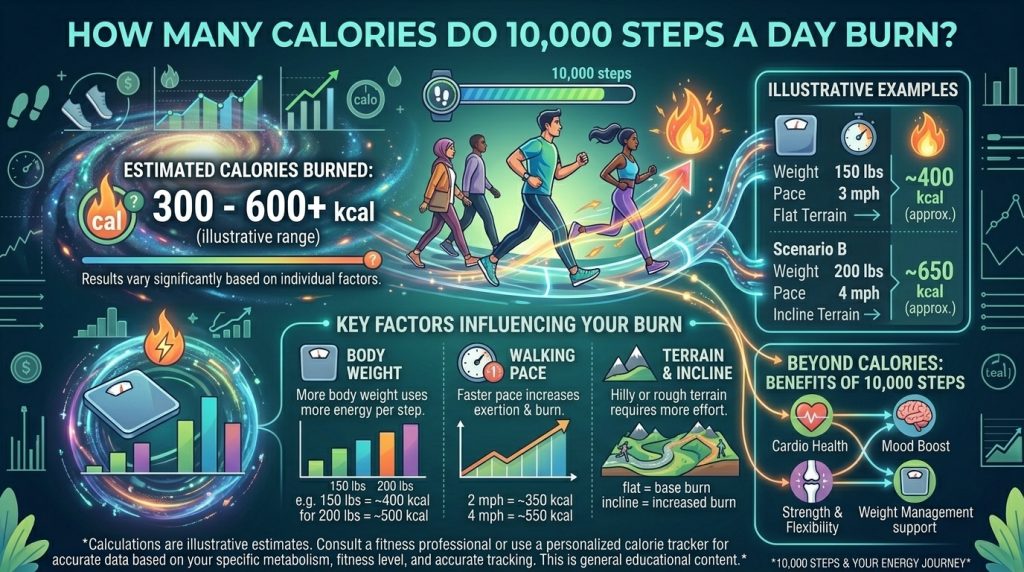
Based on my extensive review of metabolic data, a realistic range for most adults is between 300 to 600 calories burned per 10,000 steps. The final number falls on a spectrum heavily determined by your current body weight, your average velocity, and the terrain you are navigating.
2. Why does your body weight dictate how many calories you burn while walking?
It comes down to basic physics. Walking is a form of mechanical work where your muscles must push your body mass across a physical distance. A heavier body requires a significantly greater expenditure of muscular force and oxygen to move each step forward, naturally resulting in a higher total calorie burn.
3. Will tracking steps on a flat treadmill burn the same as walking outdoors?
In my experience, no. A perfectly smooth, flat treadmill belt helps pull your feet backward, slightly lowering the mechanical work required by your hamstrings. Walking outdoors forces you to push off solid ground, fight wind resistance, and make micro-adjustments for cracks and uneven pavement, which burns more energy.
4. How does your height affect the total distance covered in 10,000 steps?
Your height establishes your natural stride length. A taller individual covers more distance with every single stride, meaning their 10,000 steps could equate to 5 miles or more. A shorter individual covers less ground per step, hitting the 10,000 mark at roughly 4 miles.
5. What exactly is a MET, and how does it help calculate exercise energy?
A MET stands for Metabolic Equivalent of Task. It is a standardized medical unit used to measure the intensity of an activity compared to sitting perfectly still (1 MET). By knowing the MET value of your walking speed and multiplying it by your body weight, we can accurately calculate your precise caloric output.
6. Can you actually lose body weight just by hitting 10,000 steps a day?
Absolutely, provided your nutrition is in check. Burning an extra 350 to 500 calories a day through walking creates a steady, consistent energy deficit. Because walking is low-impact and doesn’t trigger extreme hunger spikes like high-intensity workouts can, it is one of the most reliable habits for long-term weight management.
7. What is “rucking,” and how does it drastically improve your walking calorie burn?
Rucking is simply the act of walking with a weighted backpack. By adding 10 to 20 pounds of external weight, you simulate a higher body mass. This forces your cardiovascular system and leg muscles to work significantly harder, noticeably boosting your calorie burn without putting the harsh stress of running on your knees.
8. Why do I recommend power walking over casual strolling for fat loss?
When you step up your speed to a power walk, your body moves out of a resting state and demands far more oxygen. This causes a sharper increase in your heart rate and elevates your metabolic rate, meaning you burn significantly more calories in less time compared to spreading those same steps out leisurely across the day.
9. Does walking up hills activate different muscles than flat ground?
Yes, dramatically. Walking up an incline grade shifts the mechanical load directly onto your posterior chain—specifically your glutes, hamstrings, and calves. It requires your body to lift its own weight vertically, which increases both muscular strength development and your overall metabolic burn.
10. Why should you rely on the fitness guides at Best Pogo Stick?
At Best Pogo Stick, we treat human movement and fitness gear with absolute precision. We don’t rely on fitness myths or generalized assumptions. We break down the real biomechanics, kinetic laws, and energy systems of the body to give you actionable, scientifically grounded insights so you can hit your health goals safely and effectively.
Summary Checklist: Getting the Most Out of Your Tracking
When assessing your daily movement, keep this practical summary checklist in mind:
- Focus on Distance, Not Just Ticks: Remember that 10,000 steps usually spans roughly 4 to 5 total miles depending on your height.
- Watch Your Pace: Aim to complete at least half of your daily steps in a single, focused session of continuous, brisk walking.
- Assess Your Terrain: Incorporate hills, stairs, or trails whenever possible to naturally spike your muscular engagement.
- Listen to Your Body: Use fitness trackers as a general reference guide rather than absolute, flawless scientific truth.
By understanding the real science behind kinetic movement and implementing smart, simple adjustments to your pace and route, your daily walking habit can become an incredibly powerful foundation for long-term health and vitality. For more unbiased deep dives into kinetic movement, fitness tracking, and healthy active lifestyle tools, keep your screen locked to bestpogostick.com