The best core exercises to improve your balance and stability on a pogo – July 2026
The best core exercises to improve your balance and stability on a pogo, Biomechanical Stabilization Systems, Kinetic Chain Distribution, and Anti-Rotational Conditioning Protocols
When a rider stands on an extreme, air-powered pogo stick, they are interacting with an unstable vertical system. Unlike skateboarding, snowboarding, or surfing—where the athlete manages forces across a wide horizontal surface—extreme pogo jumping requires controlling intense, linear vertical kinetic forces through a single point of ground contact smaller than a standard coaster.
                  [THE VERTICAL STABILIZATION MATRIX]

                 Shoulder Girdle / Thoracic Alignment
                                  │
                                  ▼
      Rectus Abdominis ◄───► [LUMBO-PELVIC] ◄───► Erector Spinae
       (Flexion Control)      [  COMPLEX  ]        (Extension Control)
                                  ▲
                                  │
                  Deep Pelvic Floor / Gluteal Base
The key to staying upright on a pogo stick is not just arm or leg strength; it relies almost entirely on the Lumbo-Pelvic-Hip Complex (LPHC), commonly known as the core. The core acts as the body’s primary stabilizer. It absorbs the high g-forces generated during landing compression and cleanly transfers that energy back into the upward launch without letting the spine buckle or twist out of alignment.
For bestpogostick.com, this comprehensive guide breaks down the functional anatomy of vertical balance, analyzes key regional training environments, provides an interactive training load simulator, and outlines the definitive core exercises needed to maximize your stability on a pogo stick.
SECTION 1: REGIONAL ENVIRONMENT & ATHLETIC TRAINING CONTEXTS
Your surrounding climate and local training environments play a major role in how you condition your core for high-impact vertical sports:
| Target Regional Market | Primary Training Surfaces | Environmental Stress Vectors | Targeted Core Conditioning Focus |
| California (San Francisco, Los Angeles) | Concrete action parks, oceanfront boardwalks, outdoor fitness courts. | Hard-Impact Rigidity: Hard, unyielding concrete surfaces send sharp kinetic shocks up the legs, requiring deep spinal protection. | Eccentric core stabilization to absorb heavy downward impacts without losing posture. |
| New York / Northeast (NYC Plazas, Indoor Skateparks) | Urban concrete plazas, weathered asphalt, asphalt park paths. | Surface Imperfections: Uneven, cracked urban pavement demands instant posture adjustments to stay balanced. | Reactive, fast-twitch core training to handle unexpected side-to-side movements. |
| Texas (Austin, Dallas, Houston) | Large asphalt parking areas, sprawling concrete skate complexes. | Thermal Exhaustion: High summer heat drains muscular endurance quickly, which can lead to lazy, dangerous posture mid-ride. | High-endurance core stability to maintain form even when the body feels fatigued. |
| Florida (Miami, Coastal Parks) | Smooth beachside walkways, paved multi-use trails, humid outdoor spaces. | High Ambient Humidity: Sweaty, high-moisture conditions can cause shoes to slip slightly on the pegs, threatening your balance. | Anti-rotational core strength to quickly correct unexpected body twists and slips. |
SECTION 2: THE BIOMECHANICS OF VERTICAL EQUILIBRIUM – The best core exercises to improve your balance and stability on a pogo
To build an effective training routine, we must look at how the body handles balance during the distinct phases of a pogo bounce.
1. The Kinetic Impact Phase
When the pogo stick’s rubber tip strikes the concrete, your body experiences forces that can equal 3 to 5 times your actual body weight. If your core muscles are loose or weak, this massive force will cause your lower back to arch excessively (lumbar hyperextension) or your torso to collapse forward. Can you lose belly fat by riding a pogo stick?
To stay steady, the deep muscles of your abdomen—specifically the transversus abdominis and multifidus—must contract together right before impact. This tight muscular sleeve stabilizes your vertebrae, keeping your spine locked in a safe, neutral position.
       [THE IMPACT COMPRESSION EFFECT]

       Weak, Unconditioned Core               Strong, Stabilized Core
         (Spine Buckles Forward)               (Linear Energy Transfer)
                 │                                      │
                 ▼                                      ▼
               \   /                                  │   │
                ) (  ◄── Lumbar Collapse               ├───┤ ◄── LPHC Bracing
               /   \                                  │   │
                 │                                      │
                 ▼                                      ▼
        Energy Lost / Injury Risk               Maximum Vertical Launch
2. The Mid-Air Anti-Rotational Phase
The moment the pneumatic cylinder extends and launches you into the air, you enter a brief weightless window. In this position, any slight shift of your arms or legs will cause the pogo stick to rotate or pitch underneath you.
Your inner and outer obliques are responsible for controlling this rotation. They work like diagonal guy-wires across your torso, preventing unwanted twisting and ensuring that your body stays perfectly squared over the foot pegs for a clean, upright landing.
SECTION 3: THE CORE HYDRATION & FORCE EQUILIBRIUM SIMULATOR
To help athletes determine their current core readiness and see how different muscular groups contribute to total balance stability, use this interactive diagnostic tool:
SECTION 4: THE TOP CORE EXERCISES FOR POGO STABILITY
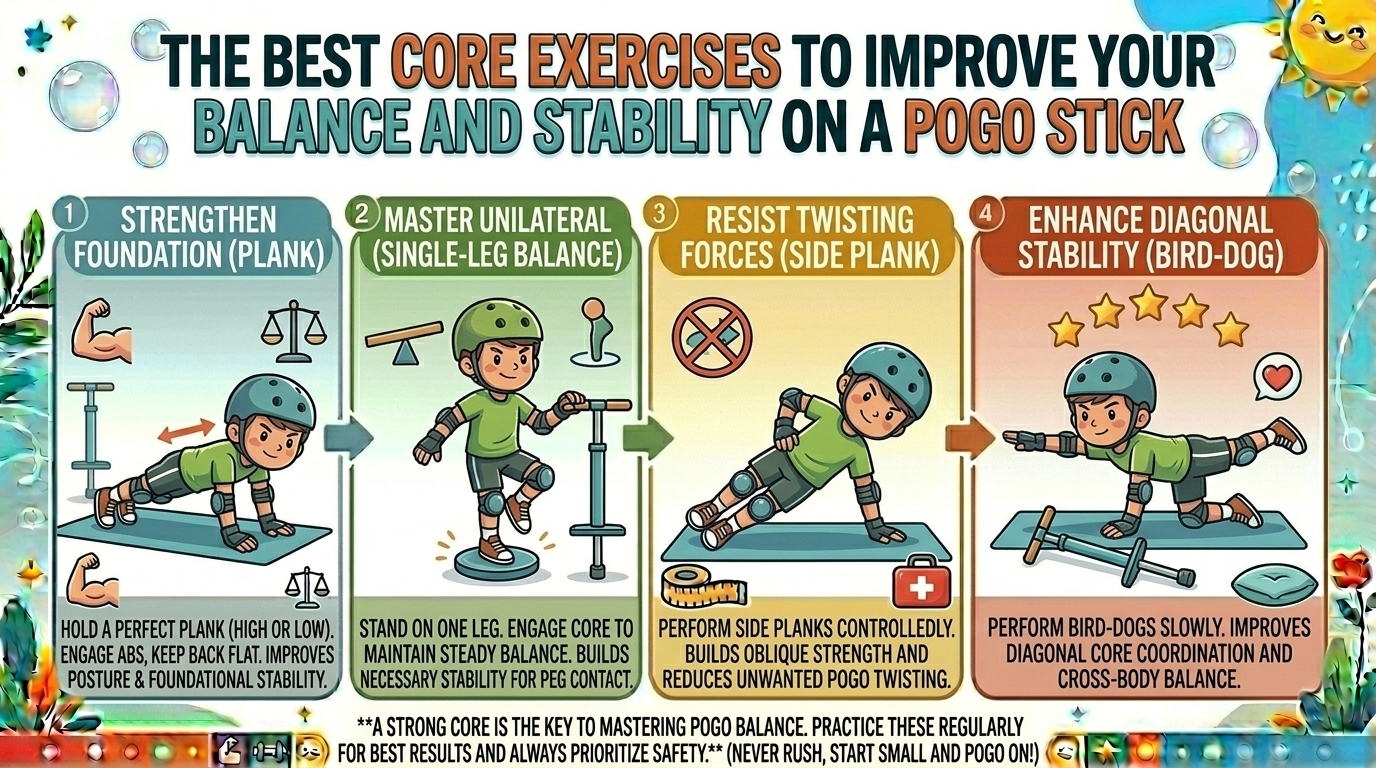
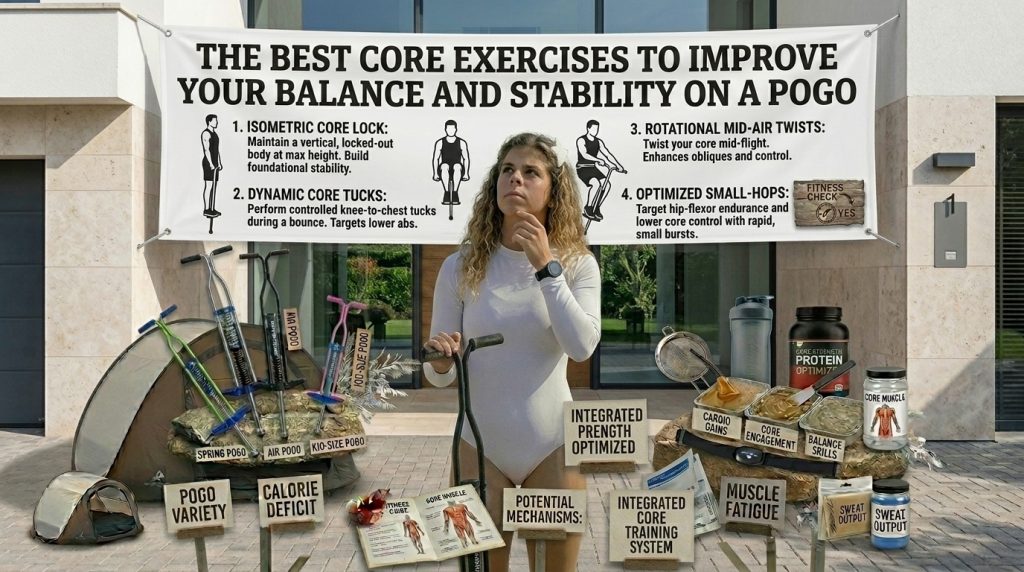
To prepare your core for the unique demands of pogo jumping, your workouts should focus on isometric bracing (holding a stiff posture against resistance) and anti-rotational control rather than simple bending exercises like sit-ups.
1. The Pallof Press
- Target Muscles: Internal and external obliques, transversus abdominis.
- Why it Matters: This is the ultimate anti-rotational exercise. It trains your core to resist an outside twisting force, mimicking exactly what happens when a gust of wind or an off-center landing tries to spin your pogo stick mid-air.
- How to Do it: Anchor a resistance band at chest height. Stand sideways to the anchor point and hold the band with both hands against your chest. Step out until you feel tension. Press the band straight out in front of you, resisting the pull to twist back toward the anchor. Hold for 2 seconds, then return your hands to your chest. Complete 3 sets of 12 repetitions on each side. Why is my air pogo stick losing pressure?
2. Unstable Over-Head Squats
- Target Muscles: Rectus abdominis, erector spinae, gluteus medius, deep foot stabilizers.
- Why it Matters: Performing squats on an unstable surface forces your deep core muscles to make constant, micro-adjustments to keep you upright, building the exact type of reflex balance needed on a pogo foot peg.
- How to Do it: Stand on the curved side of a dome balance trainer with your feet spaced hip-width apart. Extend your arms straight over your head to copy the posture of holding pogo handlebars. Keep your core tight and slowly lower into a squat, focusing on keeping the balance trainer as still as possible. Push back up to the starting position. Perform 3 sets of 10 slow, controlled reps.
3. The Hanging Knee-Raise with a Lateral Twist
- Target Muscles: Rectus abdominis, hip flexors, obliques, grip strength.
- Why it Matters: This movement targets your lower abs and hip flexors while building the grip and shoulder stability required to manage tall pogo handlebars during a high launch.
- How to Do it: Hang from a pull-up bar with an overhand grip. Keeping your legs together, use your lower abs to pull your knees up toward your chest. As your knees rise, twist them slightly to the right side. Lower your legs back down under control, then repeat the movement, twisting to the left side on the next rep. Complete 3 sets of 10 alternating repetitions.
SECTION 5: CLINICAL TIMELINE — POSTURAL PROGRESSION
When you commit to a dedicated core stabilization routine, your body goes through a structured progression that steadily improves your riding balance:
1.Neuromuscular Awakenings and Postural Awareness:Timeframe: 1 to 2 Weeks.
Your brain gets better at communicating with your deep core muscles. You will notice an immediate improvement in your daily posture, and you’ll find it easier to keep your body centered and upright during simple, straight-up-and-down pogo jumps.
2.Increased Impact Endurance and Bracing Strength:Timeframe: 4 to 6 Weeks.
Your muscles build true structural endurance. You can handle longer riding sessions without feeling tired or experiencing lower back soreness, and your torso stays stiff and stable even during deep, high-impact landing compressions.
3.Automatic Balance Reflexes and Advanced Air Control:Timeframe: 8 to 12 Weeks.
Core stabilization becomes a completely automatic reflex. Your body instantly corrects for off-center landings or mid-air twists without you having to think about it, giving you the rock-solid base needed to safely attempt advanced aerial tricks. How to increase your vertical jump using a pogo stick for sports training
SECTION 6: THE GROUND TRUTH — CORE BALANCE FAQ
1. Why does my lower back feel sore after a long pogo riding session?
Lower back soreness typically happens when a weak core allows your spine to hyperextend or sag during heavy landing impacts. This forces your lower back muscles (erector spinae) to work overtime to keep you upright, leading to fatigue and strain.
2. Are traditional sit-ups good for improving balance on a pogo stick?
Not really. Sit-ups primarily train spinal bending (flexion) and can put unnecessary stress on your lower back discs. For vertical balance sports, focus on isometric bracing exercises like planks and Pallof presses, which teach your core to stay stiff and resist movement.
3. How does grip strength connect to core stability during extreme jumps?
Through a process called radiating muscle activation, squeezing your pogo handlebars tightly sends a neural signal down your arms that automatically tells your core and shoulder muscles to tighten up, increasing your overall stability.
4. Can working on a balance board help my pogo riding skills?
Yes. Training on a balance board helps build the fast-twitch ankle, knee, and hip stabilizer reflexes necessary for managing small, quick balance shifts on pogo foot pegs.
5. How many times a week should I train my core for extreme sports?
For best results, dedicate 2 to 3 sessions a week to targeted core stabilization training, making sure to give your muscles at least 48 hours of rest between heavy workouts to recover and rebuild.
6. What role do the glute muscles play in maintaining vertical balance?
Your glutes are the foundation of your core. They lock down your pelvis and work with your lower abs to prevent your hips from tilting forward or backward, ensuring your body stays perfectly lined up over the pogo stick.
7. Why do I lean too far forward when prepping for a high bounce?
Leaning forward usually means your core muscles aren’t firing properly to support your upper body, causing you to rely on your shoulders and arms to steer the stick instead of your central mass.
8. Does a cold climate change how my core muscles perform?
Yes. Cold weather can make muscles stiff and slow to react. Always spend 5 to 10 minutes doing a dynamic warm-up (like jumping jacks or bodyweight squats) to get blood flowing to your core before jumping in chilly weather.
9. What is the single best exercise for preventing mid-air twisting?
The Pallof Press is widely considered the top exercise for this issue because it directly trains your core’s ability to fight against unwanted rotation and keep your torso squared.
10. Can wearing a weightlifter’s back belt improve my pogo balance?
No. A lifting belt provides a rigid wall for your abs to push against during heavy, static lifts, but it can restrict the natural, fast-moving hip and spine adjustments needed to stay balanced on a moving pogo stick.
Conclusion: Anchoring Your Athletic Axis
At its core, mastering vertical stability on a pogo stick is an exercise in managing high-velocity kinetic transfers. Just as a heavy-duty tent stake relies on its surface area and soil friction to anchor a shelter against unpredictable wind vectors, a high-performance athlete relies on the deep muscular bracing of the lumbo-pelvic-hip complex to anchor their body over a rapidly compressing pneumatic shaft.
Without a conditioned, reactive core, the immense G-forces generated at the impact apex will inevitably cause postural collapse, leading to lower back strain, off-axis launches, and an exponentially higher risk of severe field wipeouts.
                  [THE SYMMETRICAL REBOUND MATRIX]

     Core Isometric Bracing ──► Spine Linear Rigidification ──► Equal Force Distribution
                                                                        │
                                                                        ▼
   Effortless Aerial Recovery ◄── Maximum Rebound Thrust ◄── Peak Cylinder Compression
True progression in extreme action sports is built on a foundation of dedicated, targeted physical preparation. By shifting your training away from standard spinal flexion movements like traditional crunches and investing energy into anti-rotational control and unstable isometric bracing, you systematically build the muscular endurance and neural pathways needed to maintain a neutral spinal alignment under load.
When you treat your core as the essential piece of stabilization hardware that it is—incorporating dynamic Pallof presses, balance board work, and targeted lower-abdominal rotations into your weekly training regimen—you give yourself an unshakeable athletic axis. This foundational strength allows you to absorb heavy concrete impacts effortlessly, maintain flawless control over your frame mid-air, and push your aerial progression to higher altitudes with total safety and confidence.