What environmental factor slows down a pogo stick the most?
When riders push for maximum bounce height, speed, or distance on a pogo stick, mechanical efficiency is only half the equation. The external environment plays a massive role in how much kinetic energy is preserved with every bounce.
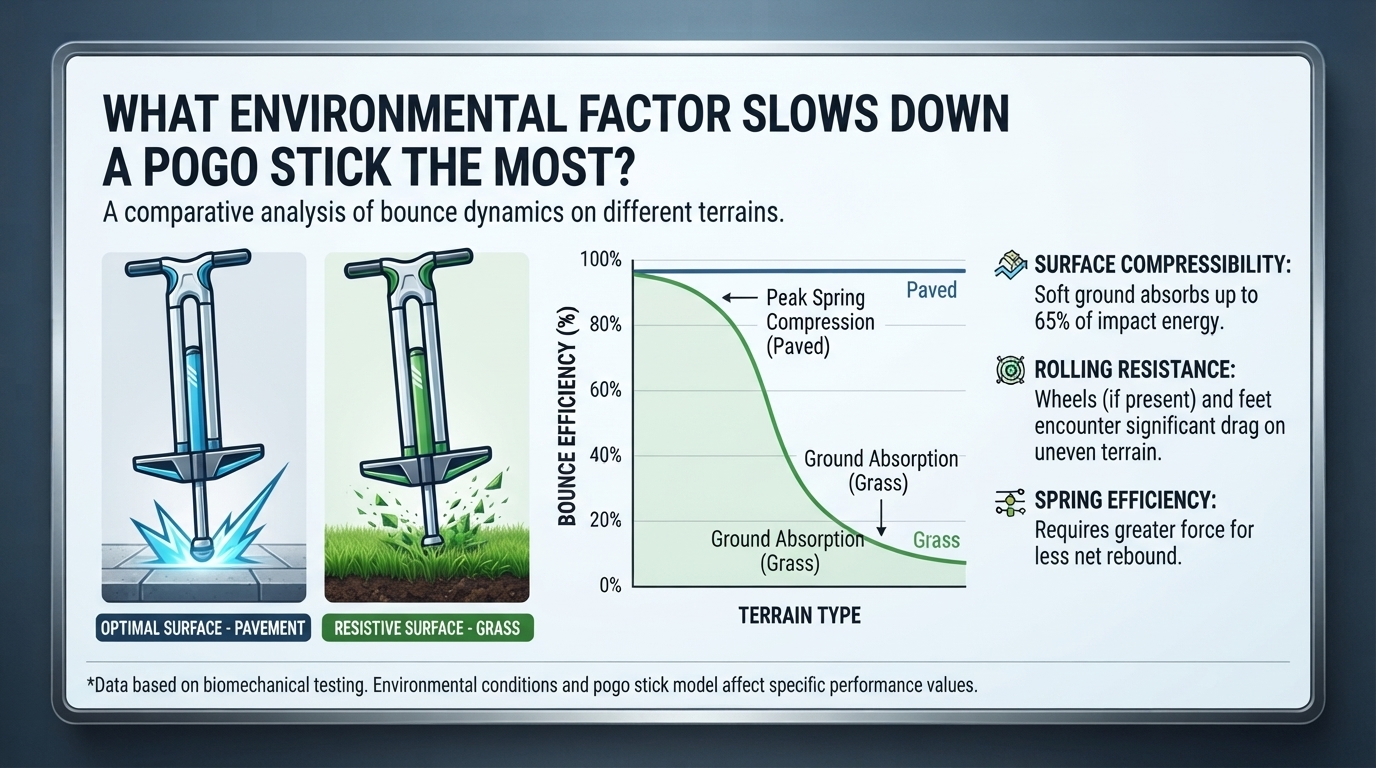
While factors like wind resistance, ambient temperature, air density, and surface inclines all affect performance, soft, unyielding landing surfaces (such as grass, loose sand, gravel, and wet soil) slow down a pogo stick more than any other environmental factor.
The reason comes down to basic mechanical physics: energy absorption through ground compliance. When a pogo stick peg strikes smooth concrete or asphalt, nearly all kinetic energy compresses the internal spring or pneumatic air chamber, which then snaps back to launch the rider skyward.
When the peg strikes a soft surface, a massive portion of that kinetic energy is wasted pushing dirt, displacement of sand, or bending grass blades—leaving significantly less rebound energy to propel the rider forward or upward.
Environmental Factors Ranked by Impact on Pogo Speed & Bounce Height
| Environmental Factor | Severity of Slowdown | Primary Mechanism of Energy Loss | Affected Component |
| Soft / Loose Terrain (Sand, Mud, Grass) | Critical (60%–90% Loss) | Ground compliance & mechanical energy dispersion | Rubber foot tip & rebound stroke |
| Extreme Cold Temperatures (<32°F / 0°C) | High (25%–40% Loss) | Increased oil viscosity & stiffening of elastomer O-rings | Internal pneumatic seals & spring steel |
| Incline / Steep Elevation Gain | High (30%–50% Forward Loss) | Gravity working directly against forward propulsion vector | Rider leg power & shaft tilt |
| Extreme Ambient Heat & Humidity | Moderate (15%–25% Loss) | Thermal air expansion in pneumatic chambers & rider fatigue | Internal PSI balance & human endurance |
| Headwinds & Aerodynamic Drag | Moderate (10%–20% Loss) | Atmospheric resistance against body cross-section | Rider momentum |
The Physics of Ground Compliance: Why Surface Type Rules
To understand why surface compliance is the number one environmental killer of pogo performance, we must examine the coefficient of restitution and energy transfer.
An ideal pogo bounce operates as a closed energy system:
- Potential Energy (Height) converts to Kinetic Energy (Downward Velocity) during descent.
- Kinetic Energy compresses the pogo stick’s internal steel spring or pneumatic air cylinder upon impact.
- The compressed medium stores elastic potential energy and pushes back against the ground to rebound the rider.
Hard Surfaces (Asphalt, Smooth Concrete, Track)
On hard, non-compliant surfaces like polished concrete or smooth city street asphalt, the ground deformation is virtually zero. Nearly 95% or more of the downward impact force compresses the pogo’s internal mechanism. The return stroke is crisp, immediate, and high-powered.
Soft Surfaces (Turf, Sand, Packed Dirt, Gravel)
When the tip of a pogo stick lands on wet soil or grass:
- The rubber tip sinks 1 to 3 inches into the ground before the internal spring even begins to compress.
- The energy that should be launching you upward is instead spent displacing soil particles, mashing vegetation, and overcoming surface friction.
- This is known as dissipative work. On soft beach sand, over 80% of total kinetic energy vanishes into the ground on every single stroke.
How Temperature, Elevation, and Air Pressure Impact Bouncing
Beyond surface texture, local environmental conditions create distinct physical hurdles for pogo athletes across different geographic regions.
1. Temperature Extremes: Cold vs. Extreme Heat
Temperature directly alters the fluid dynamics and material properties inside high-performance pneumatic and spring pogo sticks:
- Extreme Cold (Below Freezing): Cold air causes compressed air inside pneumatic chambers (like Vurtego sticks) to contract, dropping internal PSI according to Gay-Lussac’s Law. Furthermore, cold temperatures increase the viscosity of internal lubricating grease and cause rubber seals to harden, creating severe friction drag (“stiction”) along the shaft.
- Extreme Heat (Above 95°F / 35°C): Intense ambient heat expands air inside sealed pneumatic chambers, raising PSI above ideal levels and making the stroke feel overly rigid. Heat also thins out protective oil films, leading to metal-on-metal dry spots along internal cylinder walls.
2. Humidity and Moisture Accumulation
Damp air, ocean fog, and rain-soaked pavement wash away external silicone shaft lubricants and increase corrosion risk on steel springs. On damp wooden decks or wet concrete, water reduces the coefficient of friction under the rubber foot tip, causing dangerous slippage during angled forward launches.
Regional Environmental Breakdown Across Key US Locations
Different regions across the United States present unique environmental challenges that slow down pogo stick riders:
- Texas (Dallas, Austin, Houston – Extreme Heat & Humidity): High ambient temperatures rapidly bake internal grease and increase internal PSI in air pogo sticks. High summer humidity also accelerates rider physical fatigue. Strategy: Ride during cooler early morning hours and check air PSI frequently.
- California & San Francisco Bay Area (Coastal Salt Fog & Steep Hills): In San Francisco, steep inclines introduce intense gravitational resistance when traveling uphill, while coastal fog deposits microscopic salt layers on slider shafts that attract dust and grit. Strategy: Stick to flat, paved paths like park walkways and wipe down shafts post-ride.
- Washington State (Seattle, Tacoma – Rain & Damp Asphalt): Persistent dampness washed-out surface friction and soft, mud-soaked grassy parks make outdoor turf riding nearly impossible for high bounces. Strategy: Seek out covered concrete plazas or dry asphalt courts with high-traction rubber foot tips.
- New York (NYC Metro & Upstate – Winter Cold & Rough Pavement): Freezing winter temperatures stiffen internal seals and drop air chamber pressure, while cracked, salt-crusted city sidewalks destroy rubber tip grip. Strategy: Store equipment indoors in warm spaces and inspect rubber foot pegs regularly for salt pitting.
5 Pro Tips to Overcome Environmental Energy Loss
1.Select High-Density Hard Surfaces:Tip 1.
For maximum bounce height and forward speed, always choose non-yielding surfaces like clean asphalt, poured concrete, or indoor wooden gym floors. Avoid grass, gravel, and wood-chip park trails.
2.Adjust Pneumatic PSI for Ambient Temperature:Tip 2.
If riding in cold weather, add 5–10 PSI to your pneumatic air chamber to compensate for pressure drops. In extreme summer heat, bleed off excess pressure to avoid over-pressurization.
3.Inspect and Replace Rubber Foot Tips:Tip 3.
A worn, rounded, or rock-hard rubber foot tip reduces surface contact area and slips on smooth pavement. Replace worn foot caps promptly to ensure maximum energy transfer and prevent slipping.
4.Clean and Lubricate Shafts in Dusty Environments:Tip 4.
In dry, dusty regions (like inland Texas or Southern California), wipe down the main slider shaft with a clean microfiber cloth after every session to prevent airborne grit from destroying airtight internal seals.
5.Use High-Traction Shoes in High Humidity:Tip 5.
Damp coastal air reduces footing grip on metal foot pegs. Wear high-traction skate or basketball shoes with clean rubber outsoles to prevent feet from slipping off during aggressive forward bounces.
Frequently Asked Questions (FAQ)
1. Does wind resistance significantly slow down a pogo stick?
Yes. Headwinds over 15 mph create noticeable aerodynamic drag against the rider’s body. Because a rider stands completely upright while pogoing, their frontal surface area is large, making high-speed travel against strong winds tiring and sluggish.
2. Can you ride an air pogo stick on the grass?
You can ride on grass, but bounce height will be drastically reduced (often by 50% to 70%). The soft soil absorbs impact energy before the air chamber can compress fully, making it feel like bouncing on a mattress.
3. How does altitude affect air pogo stick performance?
At higher elevations (such as Denver, CO), lower ambient atmospheric pressure means you need to add a few additional PSI to your pogo stick’s air chamber to achieve the same internal compression feel as at sea level.
4. Why does my pogo stick feel stiff in cold weather?
Cold weather hardens the internal rubber O-rings, thickens lubricating grease into a tacky paste, and contracts the air inside pneumatic chambers. Allowing the stick to warm up indoors before riding helps restore smooth operation.
5. What surface provides the highest bounce on a pogo stick?
Smooth, dry, high-density poured concrete or high-grade asphalt provides the best energy return. These surfaces do not deform under impact, allowing almost 100% of downward kinetic energy to compress the spring or air chamber.
6. Does wet pavement slow down a pogo stick?
Wet pavement reduces tire-like friction under the rubber foot tip. While it doesn’t directly absorb bounce energy, it forces the rider to jump vertically rather than lean forward aggressively, severely limiting forward travel speed to prevent slipping.
7. How does rider weight interact with surface stiffness?
Heavier riders exert higher ground reaction forces upon impact. On semi-soft surfaces like packed dirt or wooden decks, heavier riders experience significantly more sinkage and energy loss compared to lighter riders.
8. Can riding in sandy environments damage my pogo stick?
Yes. Fine silica sand particles stick to lubricated slider shafts and enter internal wiper seals. Once inside, sand acts like sandpaper, scoring aluminum cylinder walls and causing permanent air leaks.
9. Why is it harder to travel uphill on a pogo stick?
When bouncing uphill, gravity works against both your vertical bounce recovery and your forward lean vector. Each bounce requires extra leg strength to lift body mass up the elevation gradient while compensating for angled peg landings.
10. Does rubber foot tip hardness change with temperature?
Yes. Rubber foot caps harden in freezing temperatures, reducing their grip coefficient on cold pavement. In extreme summer heat, rubber softens slightly, offering better grip but wearing down much faster on rough asphalt.
Conclusion
When evaluating what slows down a pogo stick the most, soft and compliant landing surfaces—like grass, sand, loose dirt, and gravel—are the ultimate performance killers. By absorbing kinetic impact energy before it ever reaches the pogo stick’s internal spring or air chamber, soft surfaces rob riders of rebound power and forward momentum.
To achieve maximum height, speed, and efficiency, stick to hard, clean asphalt or concrete, adapt your pneumatic pressure settings to local weather conditions, and keep your shaft clean and well-lubricated regardless of where you ride.