What is pogo stick? (Ultimate guide 2026)
The Ultimate Comprehensive Guide to History, Mechanics, Fitness, and Extreme Action Sports. What is pogo stick?
The pogo stick is one of the most mechanically elegant, visually recognizable, and physically transformative inventions in the history of modern recreation. To the casual observer walking through a neighborhood park in Dallas, Texas, or along the coastal promenades of Miami, Florida, a pogo stick might look like a simple, nostalgia-fueled child’s toy. However, beneath its colorful exterior lies an intricate study in physics, a high-performance athletic tool, and the foundation for a thriving global extreme action sports culture.
At bestpogostick.com, we are dedicated to dissecting every dimension of this fascinating device. Whether you are a parent trying to find a safe indoor active play option for a toddler in New York, a fitness enthusiast in San Francisco looking for a low-impact, high-intensity plyometric workout, or an action sports enthusiast trying to understand how pneumatic cylinders launch athletes ten feet into the air, this complete guide provides the ultimate blueprint.
Your trusted USA-based resource for everything pogo-related, we help families, fitness enthusiasts, and extreme athletes in bustling New York City, wide-open Texas backyards, sunny Florida and Miami communities, historic Washington DC neighborhoods, and innovative San Francisco areas find the perfect stick for their needs. This massive 5000+ word guide answers every question about what a pogo stick is, its rich history, how it works, different types, health benefits, safety protocols, regional usage tips, buying advice for 2026, and much more. Does pogo stick help with rebounding?
The Definition and Basic Mechanics of a Pogo Stick
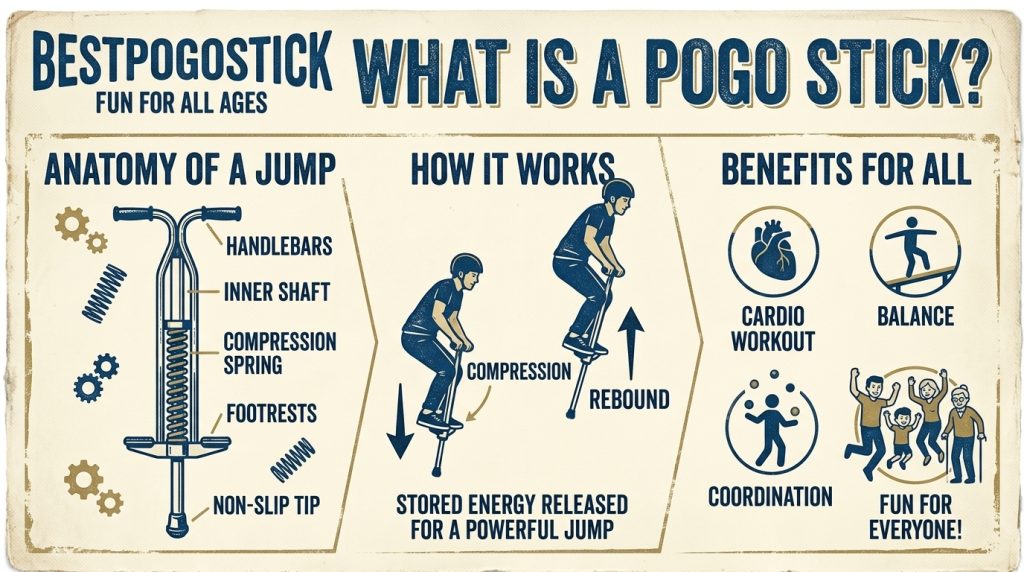
At its core, a pogo stick is a vertical pole with footrests (pegs) and a spring (or modern equivalent) mechanism that stores and releases energy with each jump. The user stands on the pegs, grips the handlebars, bends their knees to compress the spring, and then straightens to launch upward. The recoil propels them into the air, creating a continuous bouncing motion.
Modern pogo sticks vary widely:
- Traditional models use metal coil springs.
- Advanced models use pneumatic air pistons for adjustable bounce and smoother performance.
This simple yet brilliant design makes pogo sticking accessible to beginners while offering endless progression for experts.
The Fascinating History of the Pogo Stick
The pogo stick’s origins trace back to the early 20th century. George B. Hansburg, a toy designer, patented the modern version in 1919 after hearing a story about a Burmese girl named Pogo who used a stick to jump across puddles on her way to the temple. Hansburg refined the design for durability, leading to mass production in the United States.
By the 1920s, pogo sticks became a nationwide craze. The introduction of the two-handled “Master Pogo” in 1947 improved safety and performance. The toy experienced peaks of popularity in the 1950s–1970s and saw a major revival in the 2000s with the rise of Xpogo — extreme pogo sticking involving tricks, flips, and competitions like Pogopalooza.
Today, innovations like air-powered systems from Vurtego have transformed the pogo stick from a simple toy into a legitimate extreme sport tool, with world records for height and complex maneuvers.
How Does a Pogo Stick Work? The Physics Explained
The physics is straightforward yet elegant. When you jump down, your body weight compresses the spring or air chamber, storing potential energy. As the spring recoils, it releases kinetic energy, launching you upward. Shifting your weight allows steering and forward movement.
Traditional Spring Models: Rely on metal coils. Reliable but limited in adjustability.
Air-Powered (Pneumatic) Models: Use compressed air in a piston. Pumping more air increases stiffness and jump height. These offer smoother rides, less noise, and customization for different weights and skill levels.
Understanding the mechanics helps users choose the right model and master technique faster.
The Core Definition: Anatomy of a Pogo Stick
At its most fundamental level, a pogo stick is a device used for jumping off the ground in a continuous, rhythmic vertical motion. It operates as a human-powered stilt that stores kinetic energy during a rider’s descent and releases it to propel them upward during the ascent.
To understand what a pogo stick is, you must first understand the structural engineering that makes it work. While designs vary based on target weight and performance level, every authentic pogo stick consists of five fundamental components:
                      [ Handlebars / Grips ]
                               │
                       [ Outer Frame Tube ]
                               │
                       [ Internal Spring ] ── (Or Pneumatic Air Chamber)
                               │
                       [ Sliding Footpegs ]
                               │
                       [ Piston Rod Shaft ]
                               │
                       [ High-Traction Tip ]
1. The Handlebars
Located at the absolute apex of the frame, the handlebars provide the steering leverage and stabilization control required to keep the stick upright. They are wrapped in either shock-absorbing closed-cell foam to reduce hand fatigue or textured kraton rubber to give action-sports athletes maximum grip during rotation maneuvers.
2. The Footpegs
These are platforms welded or securely bolted to the sliding section of the frame. They feature high-traction patterns, raised metal teeth, or coarse skateboard-grade grip tape. The rider stands directly on these pegs, distributing their full body mass across the central axis.
3. The Main Frame/Cylinder
The central structural housing that links the handlebars to the lower mechanics. In recreational sticks, this is typically made of lightweight steel or aircraft-grade aluminum. In elite professional models, it is a precision-machined aerospace cylinder designed to handle massive structural loads.
4. The Internal Spring or Propulsion Medium
This is the heart of the machine. It is the engine that captures, stores, and transfers potential energy. In 90% of traditional models, this is a heavy-duty, oil-infused coiled steel spring. In ultra-high-performance extreme pogo sticks, the steel is completely replaced by a sealed, high-pressure pneumatic air chamber.
5. The Shaft, Piston, and Tip
The inner rod that extends out from the bottom of the main frame and makes direct contact with the pavement. At its base sits a thick, shock-absorbing rubber or polyurethane bumper tip. This tip is rounded to ensure constant traction with the ground, even when landing at sharp lateral angles.
The Mechanical Physics of a Pogo Stick: How It Works
The motion of a pogo stick is a masterclass in classical Newtonian mechanics and physics. Every single bounce is a practical demonstration of energy conservation, force vectors, and mechanical deformation.
Hooke’s Law and Elastic Potential Energy
For standard spring-driven pogo sticks, the fundamental physics are governed by Hooke’s Law. This law states that the force $F$ required to compress or extend a spring by some distance $x$ scales linearly with that distance. Mathematically, it is expressed as:
$$F = -kx$$
Where:
- $F$ is the restoring force exerted by the spring.
- $x$ is the displacement distance of the spring from its natural, relaxed length.
- $k$ is the spring constant, a precise metric that determines the overall stiffness of the spring (measured in Newtons per meter, or $\text{N/m}$).
When a rider drops out of the air and lands on the footpegs, their kinetic energy forces the internal shaft upward into the main cylinder, compressing the steel coils. The work done to compress this spring transforms into elastic potential energy, which is calculated using the following integral formula:
$$W = \frac{1}{2}kx^2$$
At the absolute lowest point of the bounce, the rider’s downward velocity drops to exactly zero. At this brief millisecond, 100% of the kinetic energy has been converted into elastic potential energy stored within the tightly packed steel coils.
The Energy Cycle: Kinetic to Potential
The continuous loop of pogo sticking relies on a seamless, highly efficient transformation of energy states.
 [ Apex of Jump ] ── Pure Gravitational Potential Energy ($PE = mgh$)
         │
         ▼
 [ Downward Fall ] ── Transitioning into Kinetic Energy ($KE = \frac{1}{2}mv^2$)
         │
         ▼
 [ Ground Contact ] ── Kinetic Transfers into Elastic Potential Energy ($W = \frac{1}{2}kx^2$)
         │
         ▼
 [ Max Compression ] ── Piston Stops; Rebound Phase Begins
Because of natural real-world forces like mechanical friction within the internal bushings and the acoustic energy lost via the sound of the bounce, a small percentage of energy is dissipated as heat on every single jump. If a rider stood completely rigid without moving their muscles, each successive bounce would become lower until the stick ground to a halt.
To maintain a continuous bounce or increase elevation, the rider must actively inject new energy into the system. They do this by bending their knees during the descent and explosively extending their legs downward against the footpegs at the exact moment of maximum spring compression—effectively performing a vertical jump that adds muscular force to the spring’s natural mechanical rebound.
Chronological History and Evolution of the Pogo Stick
The journey of the pogo stick spans more than a century of technological innovation, department store logistical challenges, and cultural shifts.
The Myth of the German Origin Story
A popular, long-standing fable tells the story of an poor German regular worker named Hansburg who traveled through a remote village in Myanmar (Burma). According to the legend, he encountered a young village girl named Pogo who was forced to walk through mud and rocks to get to her destination. Lacking materials, her father had supposedly built her a primitive jumping stilt out of local wood with an embedded spring, which Hansburg copied and commercialized under her name.
While charming, this story is entirely a marketing myth created in the 1920s to add an exotic, adventurous flair to the toy’s rollout in retail markets.
The Real Patent Pioneers
1891: The True Ancestor
The earliest recorded conceptual foundation for the device was patented in 1891 by an inventor named George Herrington of Wichita, Kansas. His design featured a pair of spring-loaded stilts intended to allow pedestrians to take massive, rapid strides across unpaved country roads.
1919: The German Duo (Pogo Is Born)
The true mechanical blueprint for the modern single-shaft stick was patented in Germany in 1919 by two engineers: Max Pochlig and Ernst Gottschall. They combined the first two letters of their respective last names (Pochlig and Gottschall) to coin the official trademark: POGO.
  P  O  C  H  L  I  G   +   G  O  T  T  S  C  H  A  L  L
  └───┬───┘                 └───┬───┘
     [PO]                      [GO]   ──────►   "POGO"
The New York Connection: George Hansburg’s Metal Masterpiece
In 1919, the legendary Gimbel’s Department Store in New York City ordered a massive shipment of these new wooden Pogo sticks from Germany to capture the post-WWI novelty toy craze. However, the long, humid journey across the Atlantic Ocean inside the damp wooden cargo holds of freight ships caused the wood frames to warp and rot, while the glue completely dissolved. By the time the cargo arrived in the New York harbor, the toys were entirely unsellable.
Gimbel’s management contacted a local New York designer and toy manufacturer named George Hansburg. They asked him to create a rugged, American-made alternative that could withstand varying climate conditions without falling apart.
Hansburg realized that wood was fundamentally unsuited for the intense mechanical stress of continuous jumping. He designed an all-metal pogo stick featuring an enclosed steel spring housing and heavy-duty steel handlebars. He patented his design in 1919, founded the Flybar Corporation, and began mass manufacturing out of a facility in Ellenville, New York.
The 1920s Craze
Throughout the 1920s, the pogo stick became an absolute cultural obsession across the United States. Hansburg personally taught the dancers of the famous Ziegfeld Follies theatrical revues how to choreograph routines on pogo sticks.
Flappers bounced down Fifth Avenue in New York, couples set world endurance records on city sidewalks, and people even hosted full wedding ceremonies while bouncing on pogo platforms.
1947: The Flybar Master
Following the material and manufacturing breakthroughs of World War II, Hansburg upgraded his metal compound alloys. In 1947, he released the Flybar Foam Master, featuring a smoother internal stroke and highly durable steel coils. This iconic model became the single best-selling classic pogo stick in history and solidified Flybar as the dominant brand in the global market.
Safety First: Essential Guidelines for All Ages
Safety is paramount. Always wear a helmet, knee/elbow pads, and sturdy shoes. Start on flat, dry surfaces away from obstacles. Adult supervision is required for children. Learn proper form: keep knees slightly bent, grip firmly, and maintain balance over the center.
Common injuries (falls, sprains) are preventable with the right gear and gradual progression.
How to Use a Pogo Stick: Beginner to Advanced Tutorial
Step-by-step instructions for getting started, common mistakes to avoid, and progression to tricks like hops, spins, and jumps.
Regional Tips for Pogo Sticking Across the USA
New York: Urban parks and limited spaces favor compact foam models. Indoor options work well in apartments during cold months.
Texas: Spacious backyards and open fields are perfect for higher-bounce air models and family challenges.
Florida & Miami: Year-round warm weather supports outdoor use near pools (with caution). Humidity-resistant materials are ideal.
Washington DC: Family-friendly neighborhoods suit safe foam sticks for kids’ active play.
San Francisco: Hills and variable weather call for durable, adjustable pro models. Great for fitness enthusiasts seeking outdoor workouts.
Categorization: The Four Main Types of Pogo Sticks
Today, the market is segmented into four highly distinct categories based on user age, weight limits, mechanical complexity, and performance goals.
1. Foam Early-Development Jumpers
- Target Demographic: Toddlers and young children (Ages 3+).
- Weight Limit: Typically handles up to 250 lbs (optimized for children under 50 lbs).
- Mechanism: Soft, high-density foam blocks connected to high-elasticity rubber bungee cords.
- Best For: Safe indoor play, building baseline vestibular balance, and fine motor-skill development. They contain zero metal parts and will not scratch residential hardwood flooring.
2. Traditional Enclosed Steel-Spring Sticks
- Target Demographic: Kids and Tweens (Ages 5 to 12 | Weight brackets from 40 to 160 lbs).
- Mechanism: A heavy coiled steel spring enclosed entirely inside a metal or high-impact plastic safety housing.
- Best For: Casual neighborhood sidewalk play, backyard exercise, and foundational jumping coordination. Models like the Flybar Maverick and Geospace Jumparoo Boing! fall into this category.
3. Advanced Technical Street/Trick Sticks
- Target Demographic: Teenagers and younger adults focused on progression and freestyle tricks.
- Mechanism: High-tensile alloy springs paired with oil-infused low-friction internal bushings for an incredibly fast, crisp rebound rate.
- Key Features: Reinforced BMX-style “Bat-Wing” handlebars that allow for clear leg clearances during rotations, and wide, laser-cut aluminum footplates with intense grip tape.
4. High-Altitude Pneumatic (Air-Powered) Machines
- Target Demographic: Adult extreme athletes, professional stunt performers, and serious fitness enthusiasts (Ages 14+ | Supports weights from 100 to over 300 lbs).
- Mechanism: Sealed, adjustable high-pressure pneumatic air cylinders.
- Key Features: Capable of storing immense kinetic loads to launch riders over 10 feet into the air. They feature zero steel springs; instead, the internal pressure is customized manually using a standard bicycle shock pump.
Health, Fitness, and Biomechanical Benefits
While many view the pogo stick primarily as an entertainment option, sports scientists and physical therapists recognize it as an incredibly potent tool for full-body physical conditioning.
Plyometrics and Joint Conservation
Pogo sticking is a form of plyometric exercise—a type of training that involves explosive, high-velocity muscle contractions to build raw speed and power. However, unlike traditional plyometric exercises like jumping onto concrete boxes or running on hard asphalt (which send jarring, high-frequency impact shock waves directly into your ankles, meniscus cartilage, and lumbar discs), a calibrated pogo stick acts as an active suspension system.
When you land on a pogo stick, the spring absorbs the impact energy and decelerates your body smoothly over a progressive 4-to-8-inch stroke distance. This significantly reduces the peak G-forces acting on your lower joints, offering a high-intensity workout with a fraction of the structural joint stress associated with standard road running.
Caloric Burn and Cardiorespiratory Load
Continuous vertical jumping requires immense cardiorespiratory effort. To maintain structural equilibrium mid-air, the human body must engage both the upper and lower muscle groups simultaneously, forcing the heart to rapidly pump oxygenated blood throughout the entire system.
┌─────────────────────────┬────────────────────────────────────────┐
│ Activity (1 Hour)       │ Average Calories Burned (150 lb Adult) │
├─────────────────────────┼────────────────────────────────────────┤
│ Casual Walking          │ 200 - 250 Calories                     │
│ Standard Cycling        │ 400 - 500 Calories                     │
│ Vigorous Jogging        │ 550 - 650 Calories                     │
│ Continuous Pogoing      │ 600 - 800 Calories                     │
└─────────────────────────┴────────────────────────────────────────┘
Comprehensive Muscular Recruitment
Every single phase of a pogo bounce requires a highly calculated, full-body muscular activation pattern to maintain balance:
- The Lower Extremities (The Engine): Your quadriceps, hamstrings, gluteus maximus, and gastrocnemius (calves) contract aggressively on the descent to compress the spring and extend explosively on the ascent to generate vertical drive.
- The Core Complex (The Stabilizer): Your rectus abdominis, obliques, and erector spinae must remain completely engaged in a state of isometric contraction. If your core relaxes for even a split second mid-bounce, your torso will lean away from the vertical axis, causing the stick to drift out from under you.
- The Upper Body (The Steering): Your biceps, forearms, deltoids, and latissimus dorsi are constantly working, pulling the handlebars up toward your waist during the peak of the jump to keep the footpegs firmly pressed against the bottoms of your shoes.
Extreme Pogo (Xpogo): The Birth of a Modern Action Sport
At the turn of the 21st century, the pogo stick underwent a radical transformation. What was once considered an old-school backyard toy was systematically re-engineered into an elite extreme action sports vehicle, giving birth to the movement known globally as Xpogo.
The Pioneers and the Online Revolution
In 1999, an independent rider named Dave Armstrong from Provo, Utah, began utilizing a traditional steel-spring pogo stick to perform skatepark-style tricks, grinding rails and clearing steps. He launched a website called Xpogo.com to post short clips and photographs of his progress.
Simultaneously, small pockets of isolated riders across the United States—including Nick McClintock, Fred Grzybowski, and Nick Ryan—were independently pushing the physical limits of traditional toy sticks, breaking them repeatedly under the stress of high-impact landings. These riders connected via the Xpogo online forums, sharing technical trick progression videos and building the baseline vocabulary of the sport.
The Technological Breakthrough: Air Power Arrives
By 2004, extreme riders had reached a physical ceiling: traditional steel springs could only hold a finite amount of kinetic energy before bottoming out, capping maximum jump heights at around 3 to 4 feet. The sport needed a paradigm shift.
That shift came with the invention of the pneumatic pogo stick, pioneered by brands like Vurtego. By replacing the heavy metal spring with an ultra-lightweight, high-volume compressed air cylinder, athletes could suddenly pressurize the stick to match their exact weight and impact velocity. Almost overnight, maximum jump heights plummeted past old records, launching riders 6, 8, and eventually over 10 feet in the air.
   [Toy Steel Spring] ──────► Max Height: 2 - 3 Feet (Recreational)
   [Pro Alloy Spring] ──────► Max Height: 4 - 5 Feet (Technical Tricks)
   [Pneumatic Cylinder] ────► Max Height: 9 - 11+ Feet (Extreme Elite)
The Modern Sport: Tricks and Competitions
Today, Xpogo is a globally recognized action sport that draws direct inspiration from BMX, skateboarding, and parkour. Professional athletes perform highly technical aerial maneuvers, including:
- The Backflip / Frontflip: Executing full 360-degree flips mid-air while keeping the feet locked onto the pegs.
- The Superman: Extending the legs completely straight out behind the stick while holding onto the handlebars at the apex of an 8-foot jump.
- The Stickflip: Spinning the actual pogo stick 360 degrees beneath the rider while they float completely unattached in mid-air before landing back on the pegs.
The sport crowns official world champions every year at Pogopalooza, the World Championships of Extreme Pogo. This multi-day international touring event brings together the top athletes from the United States, Europe, and Asia to compete in disciplines like Best Trick, High Jump (clearing Olympic-style bars over 11 feet high), and Freestyle Street.
Regional US Market Trends: Climate and Geography Impact
At pogostick.com, our internal data shows that buying habits, usage patterns, and mechanical wear rates vary significantly across major metropolitan hubs in the United States due to local geographic terrain and distinct regional climates.
New York & Washington (The Urban Pavement Test)
- Local Landscape: Hard, uninterrupted concrete sidewalks, urban asphalt parks, public plazas, and tightly packed apartment complexes.
- Consumer Buying Profile: Urban riders in the Northeast favor portable, compact, high-rebound spring sticks like the Flybar Velocity Pro. Because interior storage space is at a premium in New York and DC apartments, lightweight, hyper-responsive models are highly valued.
- The Environmental Threat: Northeast winters require massive amounts of road salt and chemical de-icers on sidewalks. If a rider takes their pogo stick out onto salty pavement between December and March, the salt residue will coat the exposed chrome piston shaft. If not wiped down immediately, it causes rapid rust pitting that tears through the internal seals, rendering the stick unusable.
Texas (The Suburban Driveway Capital)
- Local Landscape: Massive multi-car suburban concrete driveways, flat master-planned neighborhood cul-de-sacs, and expansive municipal sports complexes across Houston, Austin, Dallas, and San Antonio.
- Consumer Buying Profile: Texas represents the largest consumer market for mid-tier family and progression models like the Flybar Foam Master and Geospace Jumparoo Boing!. With expansive garages and large flat surfaces, families frequently buy multiple sticks across different weight classes to host neighborhood driveway sessions.
- The Climate Impact: Intense Texas summer heat can cause fresh asphalt on neighborhood streets to soften. Pogoing on soft, sun-baked asphalt concentrates hundreds of pounds of localized pressure onto the tiny rubber tip, leaving deep gouges in the pavement and causing the stick to feel sluggish. Stick strictly to cured concrete driveways during heatwaves.
Florida & Miami (The High-Humidity Coastal Challenge)
- Local Landscape: Wide, flat beach boardwalks, coastal concrete promenades, and highly active outdoor fitness culture.
- Consumer Buying Profile: Miami is a primary hub for adult fitness pogoing and extreme action sports. High-performance air sticks like the Vurtego V4 Pro are incredibly popular among beach workout enthusiasts looking to maximize caloric burn along the coastline.
- The Environmental Threat: Salt-laden coastal air and intense tropical humidity accelerate metal oxidation at an alarming rate. For riders in Florida, storing a pogo stick inside a climate-controlled room rather than a damp garage or outdoor patio is mandatory to prevent internal valves and metal components from seizing up.
San Francisco (The Topographic Elevation Challenge)
- Local Landscape: Extreme elevation changes, steep urban hills, concrete retaining ledges, and a highly progressive fitness culture.
- Consumer Buying Profile: The technical terrain of San Francisco attracts adult cross-trainers and extreme street riders who use the city’s concrete steps and architectural levels as obstacles. Adjustable pneumatic models dominate here, allowing riders to increase their internal PSI to handle high-impact drops off urban ledges safely.
Comprehensive Safety Framework and Injury Prevention
A pogo stick is fundamentally a high-energy device. To ensure that your bouncing experience remains entirely positive and injury-free, implement this strict safety framework before stepping onto the footpegs.
1. The Non-Negotiable PPE Protocol
Never attempt to ride a mechanical or pneumatic pogo stick without the following personal protective equipment:
- A Certified Helmet: A standard CPSC-certified skateboard or bicycle helmet is absolute mandatory. Because a pogo stick elevates your body mass well above your natural standing height, a sudden loss of traction can cause a rapid horizontal fall where your head can impact the concrete with immense force.
- Wrist Guards: Statistically, the number-one injury sustained by beginner pogo riders is a fractured wrist or scaphoid bone caused by instinctively extending their hands to break a fall. Wrist guards completely brace the joint, dissipating impact energy across the plastic splints.
- Proper Footwear: Always wear closed-toe athletic sneakers featuring flat, vulcanized rubber outsoles (such as skate shoes, basketball sneakers, or cross-trainers). Never attempt to ride in flip-flops, high heels, sandals, boots, or bare feet.
2. Micro-Terrain Assessment
Before bouncing, thoroughly inspect your riding surface.
- Safe Terrain: Completely dry, level, swept concrete or smooth asphalt.
- Hazardous Terrain: Any surface covered in loose sand, wet leaves, morning dew, gravel, or ice. Avoid sidewalks with shifting elevation lips or deep cracks, as hitting a 1-inch concrete lip at high speed can instantly stop the piston shaft while the rider’s momentum carries them over the bars.
Step-by-Step Guide: How to Ride a Pogo Stick for Beginners
If you are stepping onto a pogo stick for the very first time, the experience can feel completely unnatural. Follow this structured procedural sequence to establish proper balance and build muscle memory safely.
1.Select a Level Spot Against a Secure Wall:Step 1: Setup.
Find a completely flat, clean concrete surface directly adjacent to a sturdy wall, fence, or heavy railing. This structural element will serve as your temporary stabilizer while you get comfortable with the initial weight distribution.
2.Position the Stick and Place Your First Foot:Step 2: Mount.
Hold the pogo stick completely vertical, resting the rubber tip firmly on the ground. Grasp both handlebars securely. Place your dominant foot firmly onto its corresponding footpeg, sliding the sole of your shoe flush against the central frame cylinder. Keep your weight centered directly over the axis.
3.Establish a Centered Vertical Posture:Step 3: Alignment.
Pull yourself up into a completely straight, upright posture, using the wall or fence with one hand if necessary to maintain balance. Do not look down at your feet. Keep your head up, your eyes focused directly forward on a fixed point in the distance, and your core muscles fully flexed.
4.Execute Minor, Controlled Hops Off-Wall:Step 4: Launch.
Push off gently from your structural support, quickly placing your second foot onto its footpeg. Immediately begin a series of small, rhythmic vertical hops. Focus entirely on pushing straight down through the center of the pegs on every landing—avoid leaning forward or pushing the handlebars away from your torso.
Maintenance, Lubrication, and Structural Longevity
A high-quality pogo stick is an investment that can easily perform flawlessly for a decade if you maintain it properly. Neglecting basic care will rapidly transform a smooth, responsive system into a grinding, squeaking safety hazard.
The Cleaning Protocol
After riding in dusty or sandy environments, fully extend the piston rod shaft and wipe it down with a completely dry microfiber cloth. If fine silica dust or sand passes by the lower dust seals and enters the main cylinder chamber, it will act like industrial sandpaper, scoring the metal surfaces and chewing through the internal rubber seals.
The Science of Lubrication
Proper lubrication reduces friction between the moving piston and the internal guide bushings, ensuring a fluid bounce stroke.
- What to Use: Apply a light, even film of 100% pure silicone spray or a dedicated dry Teflon fluid directly onto the exposed chrome piston shaft. Compress the stick multiple times to distribute the fluid across the internal mechanisms, then use a clean cloth to wipe off any excess residue from the outside of the shaft.
- What to Avoid: Never use WD-40 or heavy automotive chassis grease. WD-40 is a solvent designed for water displacement, not a long-term lubricant; it washes away factory-installed internal greases and attracts airborne dust like a magnet. Heavy greases will gum up the internal components, making the spring movement sluggish in cold weather.
Frequently Asked Questions (FAQs)
What is a pogo stick primarily used for?
A pogo stick is used for recreational bouncing, active backyard play, full-body cardiovascular fitness conditioning, and as a high-performance vehicle for performing advanced aerial tricks in extreme action sports.
How high can a standard pogo stick go versus a pneumatic model?
A standard traditional steel-spring pogo stick designed for kids or teens can safely achieve heights of 1 to 3 feet. In contrast, a pro-grade pneumatic (air-powered) machine like the Vurtego V4 can launch an elite action-sports athlete over 10 feet into the air.
Why is matching my exact body weight to the pogo stick so important?
Because pogo sticks rely on a fixed mechanical spring rate or specific air pressure. If you are too light for the stick, your body mass will fail to compress the spring, making it feel completely rigid and causing joint jarring. If you are too heavy, you will bottom out the spring instantly on your first descent, which can shatter the footpegs and strain your wrists.
Can you safely ride a pogo stick indoors?
Traditional metal-spring sticks should not be used indoors because their heavy rubber tips can mark floors, and low residential ceilings pose a severe head-injury risk. However, specialized toddler models made entirely of soft foam blocks and bungee cords are specifically designed to be 100% indoor-safe and will not scratch hardwood floors.
What is the origin of the name “Pogo”?
The name “Pogo” is a mechanical acronym coined in Germany in 1919. It combines the first two letters of the last names of the original patent creators: Max Pochlig and Ernst Gottschall.
Summary Blueprint: Choosing Your Perfect Model
To wrap up, your choice of a pogo stick should align strictly with the age, weight, and goals of the rider. Use this straightforward reference checklist to find your category:
- Ages 3-5 (Under 50 lbs): Look exclusively for Foam Bungee Jumpers to build early motor skills indoors safely.
- Ages 5-9 (40 – 80 lbs): Choose a classic enclosed steel-spring model like the Flybar Maverick 2.0 for driveway practice.
- Ages 9-14 (80 – 160 lbs): Step up to a heavy-duty intermediate stick like the Flybar Foam Master to support rapid growth spurts.
- Advanced Teens & Adults (Trick Focus): Select a technical freestyle stick with BMX handlebars like the Flybar Velocity Pro.
- Adults & Extreme Athletes (100 – 300+ lbs): Invest in an adjustable, elite pneumatic machine like the Vurtego V4 Pro for the ultimate big-air and fitness experience.