Why did my pogo stick start squeaking after leaking grease?
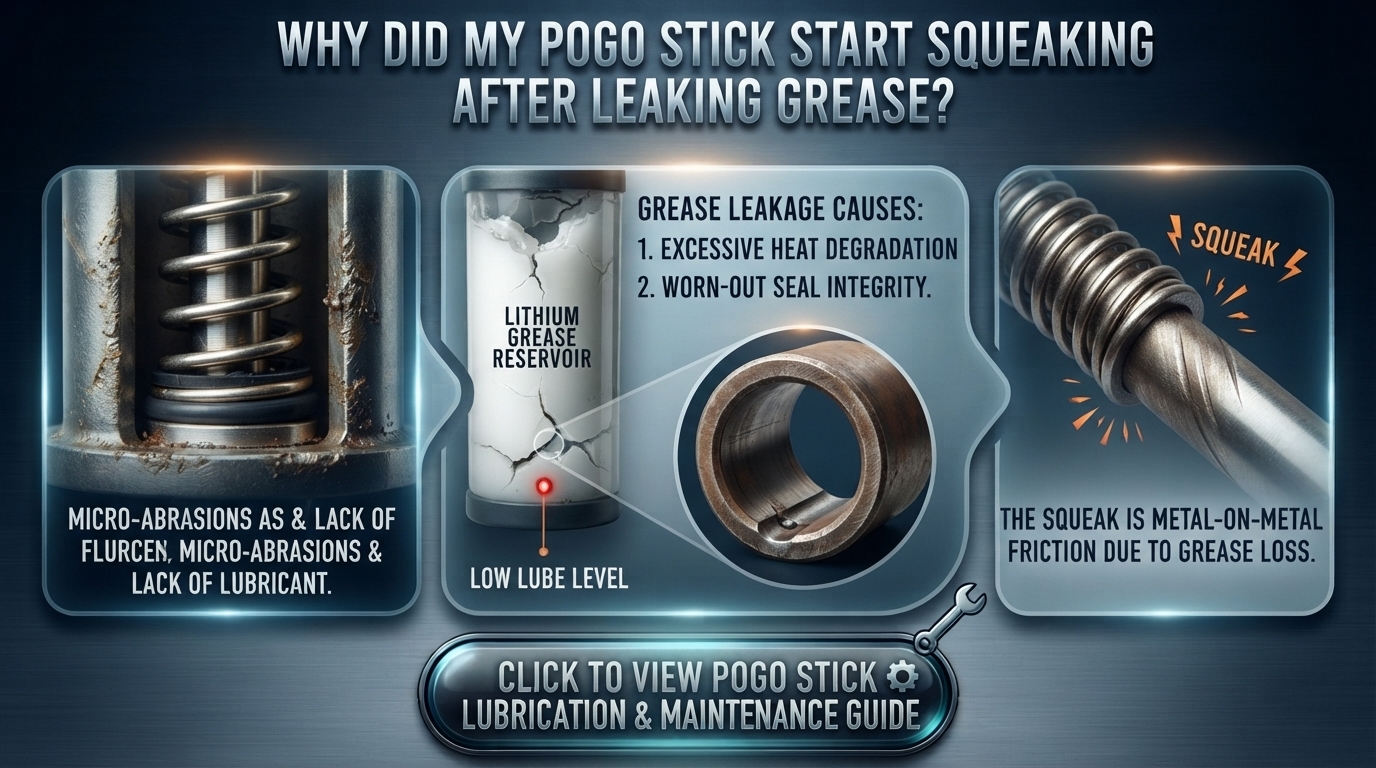
Why did my pogo stick start squeaking after leaking grease? If your pogo stick recently left a dark grease spot on your garage floor or driveway and now emits an annoying, high-pitched metallic squeak with every bounce, you are witnessing two connected stages of mechanical dry-friction failure.
Your pogo stick started squeaking because the protective factory grease that once coated the internal steel spring and sliding shaft has bled out, leaving bare metal coils to rub against the inner metal housing.
When an internal spring operates without sufficient lubrication, high-impact bouncing creates dry metal-on-metal friction. That screeching or squeaking sound is the literal vibration of bare steel grinding against aluminum or iron casing walls. Left unaddressed, dry friction leads to rapid coil fatigue, internal scoring, performance loss, and eventually a snapped spring.
This comprehensive guide breaks down the physics of dry-friction squeaking, step-by-step diagnostic procedures, climate impact across key US states, top maintenance-friendly product reviews, and an in-depth 10-question troubleshooting FAQ.
1. The Chemistry & Physics of Dry-Friction Squeaking
Inside every traditional pogo stick, a high-tension steel coil spring compresses inside a hollow cylinder shaft housing when you jump.
1. Thermal Grease Migration & Loss
Factory grease consists of base oil suspended in a soap thickener matrix. High ambient heat—such as storage in a hot summer garage, shed, or car trunk—causes the oil to thin, separate from the thickener, and seep out past the lower rubber wiper seals.
2. Breakdown of the Boundary Film
Under normal conditions, a micro-thin layer of grease acts as a cushion between the expanding/contracting spring coils and the inner walls of the shaft casing. Once the oil bleeds out, this protective boundary layer disappears.
3. Stick-Slip Phenomenon (The Squeak)
Without oil, the outer surface of the flexing spring repeatedly catches and releases against the inner cylinder wall hundreds of times per second. This rapid micro-chatter generates high-frequency acoustic vibrations—producing the loud, metallic squeak or rasping sound you hear during compression.
4. What Happens If You Ignore the Squeak?
Riding a dry, squeaking pogo stick triggers a chain reaction of mechanical wear:
[Grease Leaks Out] ---> [Bare Metal Friction] ---> [Squeaking & Grinding] ---> [Heat & Metal Fatigue] ---> [Coil Fracture / Lockup]
- Internal Cylinder Wall Scoring: Bare steel coils scratch deep grooves into the inner aluminum or steel housing tube, preventing smooth piston travel.
- Accelerated Metal Fatigue: Friction generates localized thermal stress along the spring coils, creating micro-fissures that lead to sudden spring snapping.
- Binding and Sticking: Without grease, the sliding lower piston hesitates or catches mid-bounce, creating unpredictable landing angles for the rider.
- Pulverized Rubber Dampeners: High-impact dry bottoming pulverizes internal rubber bumper washers into fine debris.
2. Regional Climate Risks: Texas, California, Washington & NY
Climate conditions across key regions directly influence how fast lubricants break down and cause squeaking:
Texas & Desert Southwest
- Climate Stress: High outdoor summer heat ($100^\circ\text{F}+$) and fine windblown dust/sand.
- Impact: Texas heat thins factory grease rapidly, accelerating leaks. Fine grit entering the lower shaft vent holes mixes with remaining dry thickener, turning the squeak into a harsh grinding sound.
California & San Francisco Bay Area
- Climate Stress: Coastal salt fog in San Francisco paired with direct high-UV heat in inland valleys (Sacramento, Central Valley).
- Impact: In inland California, heat drains internal oil. Near coastal beaches, salt air enters the unlubricated cylinder casing, causing surface rust pitting along bare steel coils within weeks.
Washington State & Pacific Northwest
- Climate Stress: Frequent rainfall, high forest humidity, and damp storage environments.
- Impact: Damp PNW weather causes water droplets to condense inside a dry cylinder shaft. Water washes away remaining oil traces and oxidizes bare steel coils, resulting in rusty orange runoff and loud creaking.
New York & Northeast Urban Centers
- Climate Stress: Radiant heat from summer asphalt/concrete park trails and cold freezing winters.
- Impact: Radiating summer sidewalk heat bakes factory grease into a hard, sticky varnish. In winter, sub-freezing temperatures harden this residue further, causing rigid compression squeaks.
3. How to Silence and Re-Grease a Squeaky Pogo Stick (Step-by-Step)
To eliminate squeaking and protect internal components, perform this 5-step maintenance tune-up:
1.Clean External Shaft & Footpads:Time: 2 min.
Wipe down the lower sliding shaft, footpads, and rubber tip with a dry cloth to remove surface dirt, dried grease residue, and road grime.
2.Unbolt the Lower Collar & Tip:Time: 3 min.
Unscrew the bottom rubber tip assembly and lower retaining collar using an Allen wrench or screwdriver to expose the inner sliding shaft.
3.Extract and Clean the Spring Assembly:Time: 5 min.
Carefully pull out the inner shaft and steel spring. Wipe away all old, darkened, grit-filled grease varnish using a shop towel lightly dampened with isopropyl alcohol.
4.Apply High-Temp Synthetic Lithium Grease:Time: 3 min.
Coat the spring coils and sliding piston guides with a thin, paper-thin layer (about 1 to 2 teaspoons) of white lithium grease or synthetic NLGI Grade 2 grease.
5.Reassemble and Test Bounce:Time: 2 min.
Reinsert the spring, tighten the bottom collar securely, and bounce 10 to 15 times on a clean driveway. The compression should be silent, smooth, and full-rebound.
4. Lubricant Comparison Table for Pogo Stick Maintenance
Using the correct lubricant formula is critical to stopping squeaks permanently without attracting grit:
| Lubricant Type | Squeak Elimination | Temperature Resistance | Safe for Seals/Rubber? | Longevity |
| White Lithium Grease (Paste) | Exceptional | High ($350^\circ\text{F}+$) | 100% Safe | 6–12 months |
| Synthetic NLGI 2 Grease | Superior | Very High ($400^\circ\text{F}+$) | 100% Safe | 12+ months |
| 100% Pure Silicone Spray | Good (Light Duty) | Moderate | 100% Safe | 1–3 months |
| Standard WD-40 Aerosol | Poor (Temporary solvent) | Low | Degrades rubber seals | Fails in 24–48 hours |
| Automotive Motor Oil | Fair | Moderate | May swell rubber tips | Leaks out immediately |
5. Gear Review: Top 3 Low-Maintenance Pogo Sticks with Easily Serviceable Springs
If your old pogo stick squeaks beyond repair, consider upgrading to a model designed with sealed housing collars or user-serviceable internal chambers:
1. Flybar Foam Master Pogo Stick (Intermediate / Youth)
- Target Weight: 80 lbs to 160 lbs
- Shaft Design: Enclosed frame with a user-serviceable lower wiper collar.
- Overview: A durable standard for growing kids, teens, and light adults. Features a wide, stable rubber tip and a lower collar that unbolts quickly, making it easy to flush out old dry grease and apply fresh lithium paste.
- Pros: Durable steel construction; comfortable foam-wrapped grips; simple disassembly.
- Cons: Factory grease should be replaced if stored in hot summer garages.
2. Flybar Super Pogo (Adult Heavy-Duty)
- Target Weight: 120 lbs to 210 lbs
- Shaft Design: Aircraft-grade aluminum housing with internal guide bushings.
- Overview: Built for heavier riders and high-impact jumping. Features heavy-gauge internal springs and tight-tolerance guide bushings that retain thick synthetic lubricants effectively.
- Pros: Heavy-duty frame rigidity; exceptional bounce response; high weight capacity.
- Cons: Substantial weight (approx. 10 lbs) requires active upper body control.
3. Vurtego V4 Pro Extreme Pneumatic Pogo Stick (Pro / All-Weight)
- Target Weight: Adjustable (100 lbs to 300 lbs+)
- Shaft Design: Sealed compressed air cylinder with dual O-rings.
- Overview: The ultimate high-altitude pogo stick. Because it relies on a compressed air piston rather than a grease-packed steel coil spring, it completely eliminates metal spring squeaking and summer grease leaks.
- Pros: Zero spring squeak; launches riders 10+ feet in the air; fully adjustable air pressure.
- Cons: Higher price point; requires periodic air pressure checks using a bicycle pump.
6. Frequently Asked Questions (FAQ)
Q1: Can I spray WD-40 directly into the lower shaft to stop the squeaking?
No. Standard WD-40 is a solvent, not a lubricant. While it may briefly silence the squeak for a few hours, it dissolves any remaining factory grease, washing it out and leaving bare metal to grind worse shortly after. Use white lithium grease or 100% silicone spray.
Q2: Is it safe to ride a pogo stick while it is squeaking loudly?
It is not recommended. Loud squeaking indicates bare metal-on-metal friction. Riding without grease accelerates coil wear, scores the inner cylinder walls, and can cause the spring to fatigue and snap unexpectedly.
Q3: Why did my pogo stick start squeaking even though I barely used it?
If a pogo stick sits unused in a hot garage or shed during summer, high ambient temperatures cause the internal grease oil to separate and bleed out over time, leaving the spring dry before you even jump on it.
Q4: How do I know if the squeak is caused by the spring or the bottom rubber tip?
If the sound is a high-pitched metallic screeching during compression, it comes from the internal spring coil. If it is a soft rubbing or squeaking sound on concrete, it comes from the rubber foot tip flexing against smooth pavement.
Q5: What type of grease is best for eliminating pogo stick spring squeaks permanently?
White lithium grease (NLGI Grade 2) or high-temperature synthetic lithium paste offers the best performance. It clings to vertical moving metal coils, resists thermal melting up to $350^\circ\text{F}+$, and repels moisture.
Q6: Can a squeaking pogo stick spring be fixed without taking the stick apart?
Yes, for a temporary fix: invert the pogo stick, apply 100% pure silicone spray generously along the lower sliding shaft, and bounce it 20 times to draw the lubricant into the lower collar. However, full disassembly and greasing provides a long-term solution.
Q7: Why is the oil leaking out of my squeaky pogo stick black or dark grey?
The dark color comes from microscopic metal filings, worn rubber seal particles, and road dirt mixing with the thinned, degraded factory oil as it bleeds past the lower collar.
Q8: Should I grease the exterior of the bottom rubber tip to stop noise?
No! Never apply grease, oil, or silicone spray to the exterior of the bottom rubber traction foot or footpads. Slippery rubber tips create a severe fall hazard on concrete and asphalt.
Q9: Can cold winter weather cause a pogo stick to squeak?
Yes. Cold temperatures harden standard petroleum grease, making it stiff and preventing it from flowing smoothly across expanding spring coils, resulting in a cold-weather creak.
Q10: How often should I re-grease my pogo stick to prevent squeaking?
For regular riders, inspect and lubricate the internal shaft every 3 to 6 months. If you live in hot climates like Texas or California, perform a pre-summer tune-up once a year using high-temperature synthetic lithium grease.
Conclusion
A squeaking pogo stick is a direct mechanical warning sign: the protective factory grease has leaked out, and bare steel spring coils are grinding against the inner casing.
By wiping away degraded oil residue, disassembling the lower shaft collar, and applying a fresh, thin coat of high-temperature white lithium grease, you can silence squeaks permanently, protect internal components, and restore a high, smooth bounce.