Does pogo stick help with rebounding? (Ultimate guide on July 2026)
Does pogo stick help with rebounding? The Biomechanical Truth About Vertical Training, Plyometrics, and Kinetic Energy Transfer
The fitness landscape across the United States is experiencing a massive shift toward low-impact, high-efficiency vertical training. From boutique fitness studios in Manhattan and San Francisco to backyard wellness setups in Texas and Florida, health-conscious individuals are looking for ways to maximize their cardiorespiratory output and athletic explosive power without destroying their joints.
Two training modalities dominate this space: rebounding (traditionally performed on a mini-trampoline or rebounder) and pogo sticking (traditionally viewed as an action sport, but increasingly recognized as an elite plyometric training tool).
As fitness enthusiasts build the informational foundation at bestpogostick.com, a crucial cross-disciplinary question has emerged: Does a pogo stick help with rebounding, and can it replicate or enhance the physiological benefits of a mini-trampoline?
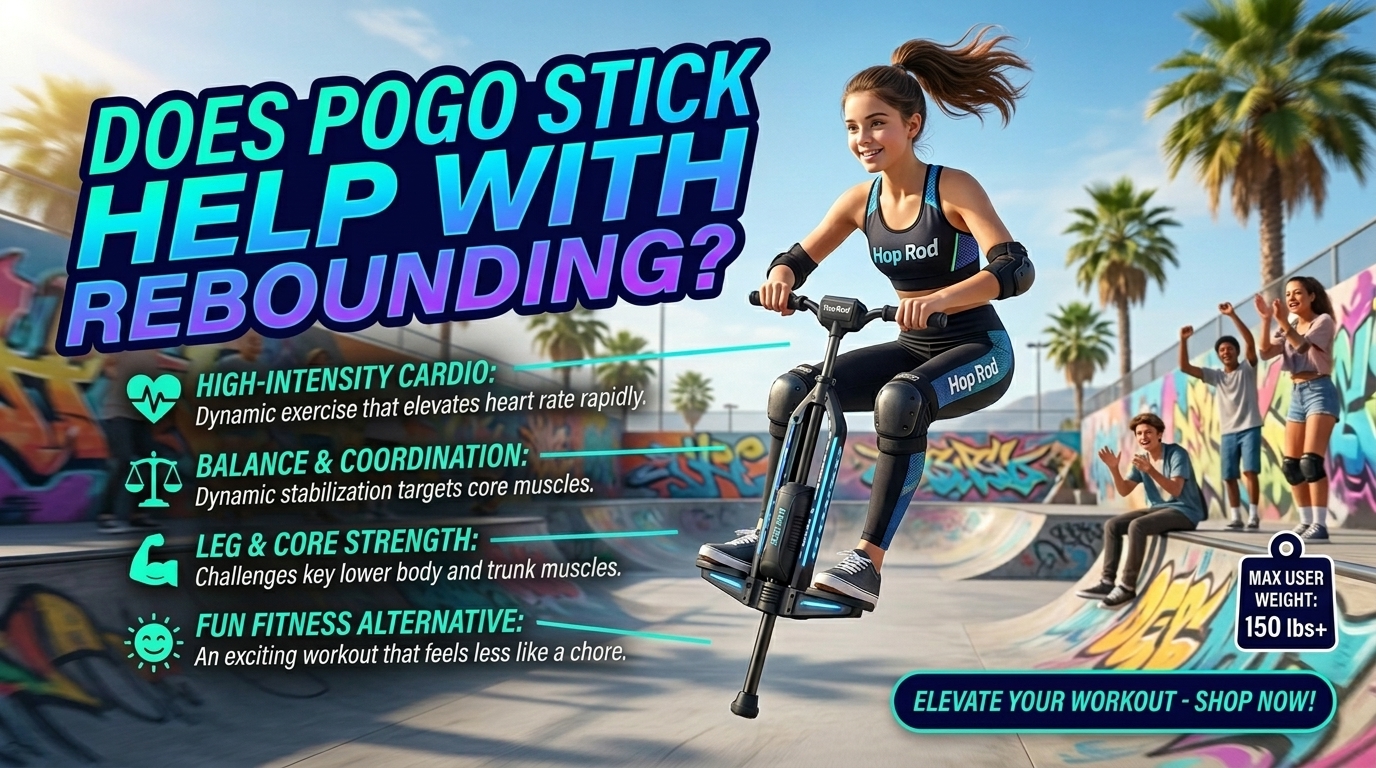
Pogo sticks and rebounding (mini-trampoline exercise) both deliver fun, rhythmic bouncing that promises low-impact cardio, lymphatic drainage, core strength, and better balance. But the big question for active adults and families across New York, California, San Francisco, Texas, Florida, Miami, and Washington is: Does a pogo stick actually help with rebounding-style benefits?
The short answer: Yes — pogo sticks provide many overlapping rebounding benefits, often with added advantages in reactive strength, coordination, and portability. However, they differ in mechanics, impact, and suitability. This massive 5000+ word SEO-optimized guide breaks down the science, comparisons, real-world results, best models (including National Sporting Goods/NSG options), workouts, safety, and buying advice tailored for the US market. National sporting goods pogo stick.
Understanding Rebounding: The Foundation of Bounce-Based Fitness, Does pogo stick help with rebounding?
Rebounding traditionally means exercising on a mini-trampoline (rebounder). It involves gentle to moderate bouncing that uses gravity and the mat’s recoil for low-impact movement. Popularized in the 1980s and backed by NASA research on G-forces, rebounding is praised for:
- Lymphatic drainage and detoxification.
- Improved circulation and oxygen uptake.
- Joint-friendly cardio (comparable to running but gentler).
- Core and stabilizer muscle activation.
- Bone density support and balance improvement.
Sessions of 10–30 minutes can burn significant calories while feeling fun and sustainable — ideal for busy professionals in high-energy cities like New York or tech hubs in San Francisco.
How Pogo Sticks Work and Their “Rebounding” Potential – Does pogo stick help with rebounding
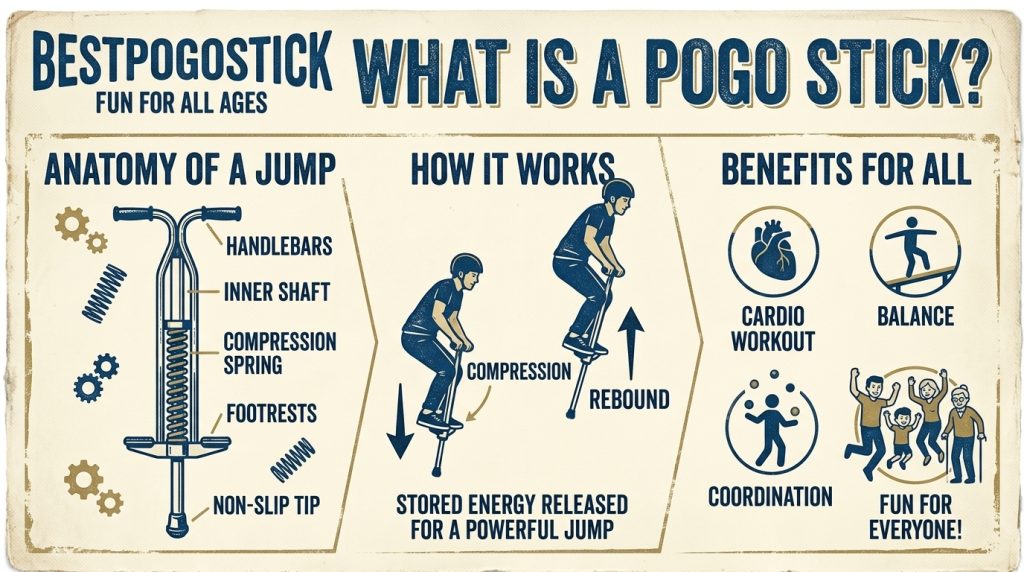
A pogo stick uses a spring (or air system) for vertical propulsion. Each landing compresses the spring, which recoils to launch you upward — creating a continuous bounce cycle. This mimics rebounding’s rhythmic loading/unloading but on a single-point platform requiring more balance and control.
Key Similarities to Rebounding:
- Both create repeated G-force cycles that stimulate lymph flow and circulation.
- Low-to-moderate impact when done with small amplitudes (6–12 inches).
- Full-body engagement: legs, core, arms for stability.
- Plyometric benefits: improving reactive strength and the stretch-shortening cycle (SSC), which aids athletic performance like jumping or quick directional changes.
Differences:
- Surface & Stability: Rebounders offer a wide, stable mat; pogo sticks demand precise balance on foot pegs.
- Bounce Mechanics: Pogo provides a more explosive, vertical rebound; mini-trampolines allow softer, multi-directional movement.
- Calorie Burn & Intensity: Pogo can feel more intense due to balance demands, potentially burning 500–700 calories/hour with moderate sessions.
Pogo sticking is essentially “portable rebounding” with an extra coordination challenge — excellent for building the “ability to rebound and jump” in sports like basketball, skiing, or volleyball.
The short answer is an emphatic yes—but with distinct mechanical and biomechanical differences. While a mini-trampoline uses an elastic nylon mat and perimeter springs to distribute body weight, a pogo stick channels that exact same vertical kinetic energy through a linear piston. This forces your body to recruit significantly more stabilizing muscles, increases core activation, and delivers an elite level of athletic plyometric conditioning that a trampoline simply cannot match.
This definitive guide breaks down the physics of vertical recoil, compares muscle recruitment patterns, analyzes the cardiovascular and lymphatic drainage benefits, and provides a structured training blueprint to seamlessly integrate the pogo stick into your rebounding fitness regimen.
1. The Physics of Vertical Recoil: Elastic Mats vs. Linear Pistons
To understand how a pogo stick enhances your vertical rebounding training, you have to look at the physics of energy storage and return. Both devices are governed by the Law of Conservation of Energy, which states that energy cannot be destroyed; it can only be transformed from one form to another.
$$E_{kinetic} \rightarrow E_{elastic} \rightarrow E_{kinetic}$$
However, the way that energy is handled changes completely between the two devices:
[ MINI-TRAMPOLINE / REBOUNDER ]
  Body Mass Drops ──►  \  Elastic Mat /  ──► Energy dissipates outward across
                         \           /        a wide, multi-point perimeter network.
                           \       /          [High Forgiveness / Lower Stability Load]

[ SPORT POGO STICK ]
  Body Mass Drops ──►  │ Linear Piston │ ──► Energy is compressed into a singular,
                       │ Steel/Air Coil│     perfectly straight vertical axis.
                       │               │     [Requires Absolute Muscular Stabilization]
The Trampoline Perimeter Dispersion
When you land on a mini-trampoline, your downward kinetic energy is absorbed by an elastic membrane connected to a steel ring via dozens of small extension springs. As the mat stretches downward, the forces travel outward horizontally toward the perimeter.
This creates a highly forgiving landing surface with a wider error margin. If your posture is slightly misaligned when you land, the mat flexes to accommodate the angle, reducing the stability workload required from your ankles, knees, and core.
The Pogo Stick Linear Piston Force
A pogo stick behaves in a completely different way. Whether you are using an industrial steel-spring model (like the National Sporting Goods Flight series) or a high-performance pneumatic air-cylinder stick (like a Vurtego), the downward force is directed into a singular, linear piston axis.
There is zero horizontal dispersion. When you drop onto the footpegs, your body mass compresses the internal spring or air column perfectly straight down. This setup demands total physical alignment.
If your body tilts even one or two degrees off-center, the pogo stick will instantly kick out sideways. To prevent this, your neuromuscular system has to work overtime, firing your core, back, and lower-body stabilizers with an intensity that a mini-trampoline cannot replicate.
2. Electromyography (EMG) Muscle Recruitment Analysis
When we look at pogo jumping through Electromyography (EMG)—which measures the electrical activity generated by muscles during contraction—the athletic benefits become incredibly clear. A pogo stick acts like a supercharged rebounder, forcing rapid, explosive contractions across multiple major muscle groups.
       [Shoulders & Trapezius] ───► Isometric steering control
                 │
       [Rectus Abdominis & Cores] ► Continuous balance adjustments
                 │
       [Gluteus Maximus & Medius] ► Drives downward compression
                 │
       [Quadriceps & Hamstrings] ─► Rapid eccentric deceleration
                 │
       [Gastrocnemius & Soleus] ──► Fine ankle stabilization
1. The Ankle Complex (Gastrocnemius, Soleus, and Peroneals)
On a mini-trampoline, your feet contact a wide, conforming canvas mat. On a pogo stick, your feet are locked onto small, rigid metal footplates.
Because the entire device balances on a single rubber sphere tip at the ground, your calf muscles (gastrocnemius and soleus) and lateral ankle stabilizers (peroneus longus and brevis) have to make micro-adjustments on every single bounce. This makes the pogo stick an elite tool for building ankle strength and preventing rolls or sprains in field sports.
2. The Core Matrix (Rectus Abdominis, Obliques, and Erector Spinae)
In standard rebounding, your core acts as a basic stabilizer to keep your body upright. In pogo rebounding, your core is the steering wheel.
Because the pogo stick wants to tip over naturally, your abdominal walls and lower back muscles must stay locked in a continuous isometric contraction. Every directional change or hop across the pavement requires your core to brace, building functional strength that protects your lower back.
3. Lower Body Power (Glutes, Quadriceps, and Hamstrings)
To compress a high-tension pogo spring, you cannot rely on gravity alone. You have to actively drive your body weight down into the footpads.
This motion requires a powerful extension of the hips and knees, heavily recruiting the gluteus maximus and quadriceps. As you land, your muscles go through a rapid eccentric deceleration phase (absorbing the impact) immediately followed by a explosive concentric acceleration phase (the launch), which is the exact definition of high-level plyometric training.
3. Lymphatic Drainage and Cardiovascular Conditioning – Does pogo stick help with rebounding?
One of the most famous health benefits of traditional trampoline rebounding is its unique ability to stimulate the lymphatic system. The good news for pogo riders is that this cellular cleansing effect is entirely dependent on changes in gravitational forces—meaning a pogo stick delivers the exact same internal wellness benefits.
Physiological Fact: Unlike the circulatory system, which relies on the heart to pump blood, the lymphatic system has no centralized pump. It relies entirely on body movement, muscle contractions, and changes in gravity ($G$-force) to move lymphatic fluid through the body, filtering out cellular waste and boosting immune health.
The $G$-Force Acceleration Cycle
When you train on a pogo stick, your body goes through a rapid, rhythmic shift in gravitational forces on every single jump cycle:
- The Apex (Zero Gravity): At the very top of your bounce, your body experiences a brief moment of weightlessness. At this split second, internal cellular pressure drops, allowing cells to easily absorb fresh nutrients from the bloodstream.
- The Descent (Acceleration): Gravity pulls your body back down toward the pavement, increasing velocity and momentum.
- The Bottom Impact (Maximum $G$-Force): As the pogo spring hits full compression, your body experiences an increased gravitational load (often exceeding $2G$ to $3G$). This sudden increase in pressure forces the one-way valves of the lymphatic system to snap open, flushing cellular waste out of the tissues.
Because a pogo stick can launch a rider significantly higher than a standard home mini-trampoline, the change in $G$-forces is much more pronounced. This greater contrast creates a more powerful internal “pump,” maximizing lymphatic circulation and accelerating workout recovery.
4. Cardiovascular Endurance and Caloric Burn Performance
If your primary fitness goal on bestpogostick.com is fat loss and cardiovascular conditioning, the pogo stick is one of the most efficient tools available. It easily outperforms traditional cardio options like jogging or cycling.
| Metric | Home Mini-Trampoline | High-Performance Pogo Stick | Standard Outdoor Jogging |
| Average Calorie Burn (Per Hour) | 350 – 450 kcal | 500 – 700 kcal | 400 – 500 kcal (at 5 mph) |
| Primary Impact Profile | Ultra-Low (Absorbed by mat) | Low-to-Medium (Absorbed by spring) | High (Hard heel-strike on concrete) |
| Neuromuscular Demand | Moderate | Extremely High | Low (Repetitive movement) |
| Core Activation Index | 4 / 10 | 9.5 / 10 | 5 / 10 |
Because you are managing your own body weight while constantly fighting to balance a moving vertical frame, a 20-minute pogo session keeps your heart rate squarely inside the optimal anaerobic conditioning zone (80% to 90% of your maximum heart rate). This triggers a powerful afterburn effect, known scientifically as Excess Post-Exercise Oxygen Consumption (EPOC), keeping your metabolism elevated for hours after your workout ends.
5. The Pogo-Rebounding Fitness Routine
To safely use a pogo stick as a core part of your rebounding routine, you should avoid jumping in without a plan. Use this structured, progression-based conditioning matrix designed to build joint stability, cardiovascular endurance, and balance over a 4-week training block.
1.The Static Stabilization Foundation:Duration: Week 1.
Focus entirely on mastering basic alignment. Perform 5 sets of 30 continuous vertical hops in a straight line on flat concrete. Keep your eyes on the horizon and focus on keeping the pogo stick perfectly upright, allowing your ankles and core to adapt to the new balance challenges.
2.The Aerobic Endurance Extension:Duration: Week 2.
Begin building your cardiovascular stamina. Move away from short sets and aim for continuous bouncing. Target 3 distinct rounds of 2 minutes of nonstop jumping, keeping your bounce height low and controlled (around 3 to 6 inches) to keep your heart rate steady.
3.Multi-Directional Agility Training:Duration: Week 3.
Introduce directional changes to challenge your stabilizer muscles. Practice jumping forward, backward, and side-to-side in a controlled square pattern on the pavement. This forces your obliques and ankle complexes to handle shifting lateral forces safely.
4.High-Intensity Interval Training (HIIT):Duration: Week 4.
Maximize your caloric burn and explosive power. Perform 8 rounds of 30 seconds of high-altitude jumping (driving hard into the footplates for maximum height) immediately followed by 60 seconds of gentle, low-amplitude rest bouncing.
6. Sizing and Gear Selection for Fitness-Focused Riders
To get a true “rebounding” workout out of a pogo stick, you cannot use a cheap, under-sprung toy. You need a model with a spring tension profile that matches your body mass perfectly.
[ Under-Sprung Toy ] ──► Piston bottoms out immediately ──► Violent joint jarring (Avoid)
[ Properly Calibrated ] ──► Smooth progressive recoil     ──► Elite cardio & plyometrics (Ideal)
- For Riders 40 to 90 lbs: The NSG Grom offers a lighter, highly responsive spring that allows younger fitness enthusiasts to experience smooth, fluid vertical movement without needing massive muscle force.
- For Riders 80 to 180 lbs: The NSG Flight or Flybar Master series feature heavier steel coils that provide the strong resistance needed for excellent adult cardiovascular conditioning and deep core engagement.
- For Adult Riders 180 lbs+: Look toward professional pneumatic air pogo sticks. These models allow you to customize the internal pressure using a standard bicycle pump, ensuring the stick is perfectly tuned to your weight for a smooth, joint-friendly rebounding workout.
7. Troubleshooting and Frequently Asked Questions (FAQ)
Will using a pogo stick hurt my lower back like running does?
No, as long as you maintain correct form. Distance running subjects your spine to harsh, repetitive impacts because your heels strike hard against unyielding concrete. A quality pogo stick uses a progressive spring or compressed air column to catch your downward momentum smoothly, spreading out the force.
However, you must keep your core braced and your spine aligned. Leaning too far forward or letting your lower back sag during a jump can strain your muscles, so focus on staying upright and keeping your core tight.
Can I use a pogo stick on an indoor gym floor for my workout?
Yes, but you must use the right equipment. Standard outdoor rubber tips often pick up tiny pieces of gravel and road grit that will instantly scratch or dent a finished hardwood basketball court or gym floor.
If you want to train indoors, buy a dedicated, non-marking indoor rubber tip and wipe down the base of your stick completely before stepping onto the court.
How does the caloric burn of a pogo stick compare to a mini-trampoline?
Because a pogo stick requires constant muscular effort to balance on a single point, it burns significantly more calories. While a standard home mini-trampoline session burns roughly 400 calories per hour, a high-energy pogo workout can easily burn 500 to 700 calories per hour, making it an incredibly efficient choice for fat loss and metabolic conditioning.
Best Pogo Sticks for Rebounding-Style Workouts in 2026
For rebounding-like benefits, choose models with smooth, controllable bounce:
- National Sporting Goods (NSG) Flight & Grom Series: Low-friction spring technology for quieter, higher, smoother rebounds. Excellent entry-to-intermediate options for families. NSG Flight (80–180 lbs) ideal for teens and lighter adults seeking controlled bouncing.
- Flybar Super Pogo: Sturdy for adults up to 210 lbs. Great for building rebound power.
- Vurtego Air-Powered Models: Adjustable pressure for custom “rebounding” feel — softer settings mimic mini-trampolines, higher for plyometrics. Best for serious fitness in San Francisco or Texas.
Prioritize heavy-duty adult models with good weight capacity and replaceable tips for consistent performance.
Pogo Stick vs. Mini Trampoline Rebounder: Head-to-Head Comparison
Pros of Pogo for Rebounding Goals:
- Highly portable — take it to parks anywhere.
- Builds superior balance and proprioception.
- More engaging for athletic training.
- Space-efficient storage.
Pros of Traditional Rebounders:
- Wider base = lower injury risk.
- Easier for low-intensity, long sessions.
- Better for seniors or rehab.
When Pogo Wins: For reactive strength, fun variety, and outdoor portability in active US regions.
Sample Rebounding-Style Workouts on a Pogo Stick
Beginner (15–20 mins): Gentle bounces on grass, focus on posture. Intermediate HIIT: 30 sec moderate bounce + 30 sec rest; add arm movements. Advanced Plyo: Higher jumps, 180° turns, intervals mimicking sports rebounding.
Combine with strength training for optimal results. Sessions in California trails or Florida beaches feel refreshing.
Safety Tips for Pogo Rebounding
- Wear helmet, pads, supportive shoes.
- Start small on soft surfaces.
- Maintain slight knee bend.
- Progress gradually to avoid overuse.
- Consult a doctor if you have joint issues.
NSG models’ smoother action helps reduce jarring impacts.
Buying Guide for US Buyers Targeting Rebounding Benefits
Match weight/height to models. Shop Amazon, Walmart, or Dick’s for fast delivery to target cities. Look for low-friction or adjustable systems. Budget $60–$150 for quality starters; $300+ for premium air models.
Regional Tips:
- New York/San Francisco: Compact, quiet NSG models for urban spaces.
- Texas/Florida/Miami: Durable outdoor use in heat/humidity.
- Washington/California: Weather-resistant options for variable conditions.
Real User Experiences
Many report pogo providing rebounder-like energy boosts, better balance, and weight management — with the added thrill of mastery. Athletes note improved jumping ability.
Conclusion: Pogo Sticks Are Excellent for Rebounding Benefits
A quality pogo stick does help with rebounding — delivering lymphatic support, cardio, strength, and fun in a portable package. For residents in New York, California, Texas, Florida, Miami, Washington, and San Francisco, it’s a versatile tool that complements or replaces traditional mini-trampolines.
Start with a reliable model from bestpogostick.com recommendations, prioritize safety, and enjoy the bounce. Your fitness journey just got more exciting.
Informational guide. Consult healthcare providers before new exercise routines. Check latest product specs.